
How to Sell SEO Services to Clients: A Practical Agency Guide
Quick Takeaways
- Nail down your scope of services and ideal client profile before you start prospecting — selling everything to everyone leads to poor delivery and high churn.
- Do your homework before the pitch: pull the prospect’s current rankings, identify 3–5 winnable keyword opportunities, and run a competitor gap analysis so you arrive as a consultant, not a salesperson.
- Always frame SEO as a revenue channel, not a technical service — every conversation should tie back to traffic, leads, and revenue.
- The three unavoidable objections — “how long will it take?”, “we tried SEO before”, and “it’s too expensive” — all have strong, honest responses if you prepare them in advance.
- Use rank tracking data and traffic projections to make your proposals concrete and compelling — vague promises lose deals.
- A well-structured proposal that includes estimated impact, timelines, collaboration model, and case studies dramatically increases close rates.
- Monthly rank tracking reports are your single best client retention tool: they make invisible progress visible and give clients a reason to stay before the big traffic gains arrive.
If you want to grow an agency (or your freelance portfolio), you need to get good at selling SEO. It doesn’t matter how good you are at keyword research, ranking sites, and building backlinks if you can’t get the clients in the first place.
SEO isn’t the easiest thing to sell. There are often misconceptions about how SEO works, the results it should yield, and how much it should cost. Clients have been burned before, they’ve heard the horror stories, and they’re skeptical — rightly so.
In this guide you’ll find practical strategies to clarify your offerings, handle objections, write better proposals, and win more deals — plus a specific section on how to retain clients by proving ROI every single month.
Table of Contents
- Preparing to sell SEO
- Define your scope of services
- Who should you sell SEO to? (ICP examples)
- SEO pricing models and what to charge
- Prepare your team and tools
- Do your homework before the call
- Lead with business outcomes, not technical terms
- Show them the gap
- Check if your prospect is a good fit
- Ask the right questions
- How to handle common SEO sales objections
- Focus on revenue and ROI
- How to demonstrate ROI with rank tracking data
- Retain clients by proving ROI every month
- Find quick wins
- Write case studies
- Write a winning SEO proposal
Preparing to sell SEO
Before you start selling, make sure the foundations are in place: what you’re selling, who you’re selling it to, and that you’re actually able to deliver.
Decide on your scope of services
The very first thing to do is establish which services you’ll offer.
SEO can be broken down into several different service offerings, some more specialized than others. The most common SEO services to sell are:
- Fully managed SEO
- Link building
- SEO consultancy / advisory
Within those, there are several different elements that could also be sold as standalone services:
- Technical website audits and fixes
- Keyword research and content briefing
- Writing optimized content
- On-page optimizations
The service you offer will largely depend on your experience, resources, and the type of client you’re working with.
Link building, for example, is most often bought by companies that already have an in-house SEO manager handling the rest. On the other hand, a small local business is more likely to need a full service.
Also consider whether you’ll produce content for clients. Beyond link building and technical SEO, a huge part of delivering an SEO service is researching and planning content. Some agencies stop at briefing; others go all the way through to production. Make sure everyone is clear on who is responsible for what.
Who will you sell to?
Once you know what you’re selling, figure out who you’re selling it to. It’s perfectly fine to work across a broad range of industries — but there’s almost certainly a type of client that is “best fit” for you.
Niching down by vertical, business model, or company size allows you to develop real expertise, command higher prices, and build more compelling case studies. Here are three high-value ICP examples worth considering:
Local businesses Local service businesses (plumbers, dentists, law firms, estate agents) make excellent SEO clients. They have a clear geographic target, defined competition, and a high average customer value relative to the cost of SEO. A single new customer can justify months of retainer spend. Building a track record here can be the foundation of a successful SEO agency.
E-commerce brands E-commerce SEO has huge upside — category pages, product pages, and informational content all have clear commercial intent. Revenue attribution is relatively straightforward because you can tie organic sessions directly to transactions. The challenge is that results take time and competition is fierce, so clients need the right expectations.
SaaS companies SaaS SEO is a specialist discipline with strong demand. SaaS companies need informational content, comparison pages, and feature pages that drive trial sign-ups and demos. Because customer lifetime value is high (often $5,000–$50,000+ ARR per customer), the ROI case for SEO is compelling.
Take a minute to decide whether you’ll niche down or cast a wider net.
SEO pricing models and what to charge
One of the most common stumbling blocks when selling SEO is pricing. Clients ask “how much does SEO cost?” and the honest answer — “it depends” — is frustrating for everyone. Being able to explain your pricing model clearly and confidently is a competitive advantage.
Monthly retainer
The most common model for ongoing SEO work. You agree on a fixed monthly fee in exchange for a defined scope of services delivered each month.
Typical ranges:
- Freelancers / solo consultants: $500–$2,500/month
- Small agencies: $1,500–$5,000/month
- Mid-market agencies: $3,000–$15,000/month
- Enterprise / specialist agencies: $10,000–$50,000+/month
Retainers provide predictable revenue for you and predictable costs for the client. The challenge is scoping them correctly so you don’t over-deliver for the fee.
Project-based pricing
A fixed fee for a defined deliverable — typically a site audit, a technical fix implementation, a content strategy, or a link building campaign.
Typical ranges:
- SEO audit: $500–$5,000 depending on site size and depth
- Content strategy: $1,000–$3,000
- Link building campaign (10 links): $1,500–$5,000+
Project work is a great way to get a foot in the door with a new client. Deliver a great audit, then propose an ongoing retainer to implement the findings.
Hourly consulting
Less common for agencies, but popular for freelance SEO consultants who advise in-house teams.
Typical ranges: $75–$250/hour for experienced consultants.
Performance-based pricing
Some agencies offer pricing tied to ranking improvements or revenue generated. While attractive to clients, this model carries risk for you — SEO results are influenced by many factors outside your control (algorithm updates, client website changes, competitor activity). If you offer this model, include a base retainer to cover costs and tie the performance bonus to meaningful outcomes like revenue, not just rankings.
How to justify your price
The key is always to frame cost relative to outcome. If a plumber’s average job is worth $400 and they close 30% of leads, a single new organic lead is worth $120. If you can generate 20 leads/month through SEO, that’s $2,400/month in value. A $1,500/month retainer looks like an obvious investment.
Use this kind of arithmetic in every sales conversation.
Preparing your team & tools
Resourcing versus sales demand is a constant battle for a growing agency. It’s easy to overwhelm yourself or your team by taking on projects you aren’t ready for.
Having the right people in place is essential, but the right tools can do a lot of the heavy lifting too. Here are the core categories to think about:
Rank tracking and reporting Starting with a multi-feature tool like Nightwatch will cover a lot of bases. Nightwatch can help you track rankings accurately (including at a local level), analyze backlinks, conduct technical site audits, and generate client reports. When you’re running SEO performance reporting for multiple clients, having clean, shareable data is essential to retaining clients and demonstrating value.
Keyword and competitor research Tools like Ahrefs or Semrush are standard for keyword research and competitor gap analysis.
Lead sourcing Tools like Apollo.io or Hunter.io for finding prospects and verifying email addresses.
Billing and operations An invoicing and CRM tool to manage proposals, contracts, and payments — essential as you scale your SEO agency.
Do your homework before the call
The single biggest mistake agencies make when selling SEO is showing up to a discovery call empty-handed. If you walk in with generic slides about “our proven process” and no data about the specific prospect, you’re just another vendor. The way to stand out is to arrive having already done a portion of the work.
Run a quick site audit before the meeting. A 20-minute crawl with Screaming Frog will surface the most visible technical issues: broken links, missing title tags, pages blocked from indexing, slow page speeds. You don’t need a comprehensive audit — you need three to five specific, fixable issues you can point to. This signals seriousness and gives you something concrete to discuss.
Pull their current keyword rankings. Use a rank tracking tool to check where the prospect currently ranks for their most important commercial keywords. Many prospects have no idea where they stand. Showing them “you rank position 18 for [your main product keyword], which means you’re getting roughly 1% of the available traffic” makes the problem concrete and urgent.
Identify 3–5 specific, winnable opportunities. Look for keywords where the prospect already ranks between positions 8 and 20 — “near-miss” opportunities where a focused push could move them to the first page relatively quickly. Low-to-medium competition keywords with meaningful search volume that competitors rank for but the prospect doesn’t are equally valuable. Come to the call with a short list of specific targets, not a vague claim that “there’s a lot of opportunity.”
Research what competitors rank for that the prospect doesn’t. A competitor keyword gap analysis will show you keywords that two or three of the prospect’s direct competitors rank for in the top ten, while the prospect ranks nowhere. This reframes SEO from “getting traffic from Google” to “not ceding market share to your competitors” — a far more motivating frame for most business owners.
This preparation turns the sales call from a pitch into a consultation. You’re not trying to convince them to buy something — you’re showing them a picture of their current situation, which makes the case for your services better than any script could.
Lead with business outcomes, not technical terms
This is the most important principle in selling SEO, and it’s where the majority of agencies fail.
When you say “we’ll improve your Core Web Vitals score,” a client hears an abstract metric they can’t connect to their business. When you say “we’ll make your site load fast enough that Google stops penalizing it in rankings,” they hear a reason for their current underperformance. One creates confusion; the other creates urgency.
Translate everything into the language of business outcomes:
- Instead of “we’ll build topical authority,” say “we’ll make sure Google sees your site as the go-to source on [topic] so it ranks you above competitors.”
- Instead of “we’ll optimize your internal link structure,” say “we’ll make sure your best pages get full credit for the work you’ve already done on your site.”
- Instead of “we’ll improve your E-E-A-T signals,” say “we’ll make your content more credible so Google trusts it enough to show it to searchers.”
The frame for every claim is: traffic → leads → revenue.
The keyword traffic calculator is the most powerful tool in any SEO pitch. Here is the formula:
- Take the monthly search volume for a target keyword (e.g. 2,000 searches/month)
- Apply a realistic click-through rate for position 1 (approximately 25–27%, per Advanced Web Ranking’s CTR study)
- Apply the prospect’s website conversion rate (use 2–3% if unknown)
- Multiply by their average sale or lead value
Example: 2,000 searches × 27% CTR = 540 visits/month. At a 2.5% conversion rate, that’s 13.5 new leads per month. If each lead is worth $500, ranking #1 for that keyword is worth approximately $6,750/month in pipeline. Now compare that to what they’re paying for the same traffic on Google Ads at $8 per click — $4,320/month, and it stops the moment the budget runs out. This calculation doesn’t need to be precise; it needs to be directionally compelling.
Show them the gap
Abstract opportunity claims are forgettable. Specific competitive data is not.
The most persuasive moment in any SEO sales call is when you can show a prospect: “Your competitor ranks #1 for this keyword and gets an estimated 600 visits per month from it. You rank #24 and get almost none. Here is exactly what we would do to close that gap.”
How to build a competitor gap presentation: Pull the top three to five direct competitors for the prospect’s main business category. Using a rank tracking or keyword research tool, identify keywords where those competitors rank in positions 1–10 while your prospect ranks below position 20 or doesn’t rank at all. Sort by search volume to prioritize the highest-value gaps.
For each gap, estimate the traffic impact. Most keyword research tools provide traffic estimates for specific positions — if Competitor A ranks #1 for a keyword with 1,500 monthly searches, they’re getting roughly 375–400 visits per month from that single keyword. The prospect is getting zero.
Showing three to four of these gaps in a simple table — keyword, competitor ranking, estimated competitor traffic, prospect’s current position — makes the stakes tangible. You’re not selling an abstract future benefit; you’re showing them money they’re leaving on the table right now.
Visual presentation matters. A clean chart in a PDF report lands completely differently from a rough number in a spreadsheet. Use tools that generate professional-looking summaries — white-label reports from your rank tracking platform let you present data under your agency branding rather than forwarding raw exports, which signals the quality of your work even before the engagement starts.
How to sell SEO: tips & strategies to close more deals
The specifics of selling SEO will change every time depending on who you’re selling to and what you’re selling. That said, some fundamentals always apply.
Check if your prospect is a good fit
Before you spend time crafting a proposal, check that the client is actually a good fit. A bad-fit client will churn quickly, damage your reputation, and take up disproportionate time. Here’s what to assess:
1. What’s the SEO potential?
Some businesses can scale significantly with SEO. Others are limited. For some small local businesses, even ranking #1 for every relevant keyword wouldn’t generate enough search volume to produce a meaningful ROI. Basic keyword research will answer this quickly.
Similarly, an innovative early-stage company might not yet have any search demand. If people don’t know to search for the product category, other channels (paid social, influencer) are more appropriate.
2. What’s their in-house resource?
A lot of SEO work is about recommendations. Are they in a position to execute? If not, do they have additional budget to outsource content creation, or is that part of your service? Make sure there’s no ambiguity.
3. Can they afford to invest?
SEO doesn’t need to take 12+ months to reach ROI — but it’s still not the fastest channel. If a business owner needs to see positive ROI within 60 days or the business goes under, SEO is probably not the right channel for them right now. There should be a long-term mindset and budget to match.
Ask the right questions
Before any proposal, gather the data you need to make it compelling. Here are five areas to cover:
1. Average customer value
This helps you calculate the breakeven point for your services. In e-commerce: average cart value and repeat purchase rate. For SaaS: average monthly recurring revenue per customer multiplied by average retention in months. For local service businesses: average job value. Figure out how many customers through SEO are needed to make the investment profitable.
2. Measuring success
Agree on a primary KPI:
- E-commerce: transactions or transaction value
- Sales-led SaaS: demo bookings or SQLs
- Product-led SaaS: trial sign-ups
- Local business: enquiries or calls
Also agree on attribution model (last click, first click, assisted) so there’s no ambiguity later.
3. Competitors and positioning
Ask for a list of their main competitors, then supplement with your own research — see who’s ranking for key terms. Also understand their positioning: how are they different from competitors? This shapes your content strategy and helps you speak their language.
4. Current and past SEO activity
If this company has done SEO before, learn what worked and what didn’t. If they’ve worked with an agency, find out what was good and bad about the experience. This intelligence helps you tailor your pitch and avoid the same mistakes.
5. Other marketing channels
If they run paid search, ask to see their top converting queries. Organic and paid often complement each other — if they know paid search works for them, it’s an easier sell to double down on those same keywords organically.
How to handle common SEO sales objections
Every sales process involves objections. The best salespeople don’t try to dismiss them — they acknowledge them and respond with specifics. Here are the most common objections you’ll encounter when selling SEO, and how to handle them.
”SEO takes too long — we need results now.”
Acknowledge it: “You’re right that SEO is a longer-term investment compared to paid ads. That’s a legitimate concern and one we take seriously.”
Respond with specifics: “In the first 60–90 days, we typically focus on quick wins: fixing technical issues, optimizing existing content for intent, and targeting lower-competition keywords. These often produce measurable movement within weeks. At the same time, we’re building toward bigger wins at the 6–12 month mark. Here’s an example from a recent client where we moved the needle in month one…”
Show a rank tracking chart from a previous client. Real data beats abstract promises every time.
”We tried SEO before and it didn’t work.”
Acknowledge it: “That’s one of the most common things I hear, and it’s usually because SEO was done without a clear strategy or without the right expectations being set.”
Diagnose it: “Do you know what specifically was done? Was there a content plan? Were rankings tracked? Were there any technical issues on the site?” Often, past “SEO” was either low-quality link building or random content creation without a keyword strategy. By understanding what didn’t work, you can differentiate your approach.
Position your difference: “What we do differently is [x]. Here’s how that’s worked for clients in similar situations…"
"Can’t we just do Google Ads instead?”
Acknowledge it: “Google Ads is a great channel — it’s fast and highly controllable. A lot of our most successful clients use both together.”
Explain the complementarity: “The difference is that ads stop the moment you stop paying. SEO builds a compounding asset. Every piece of content you rank for keeps driving traffic without an ongoing spend per click. For a business like yours, the CPCs in your industry are [X], which means organic traffic is worth [Y] per month if we achieve the traffic targets I’ll show you.”
Pull real CPC data from Google Keyword Planner or their own Ads account if they share it. Make the dollar value of organic traffic concrete.
Handling the “AI is replacing SEO” objection
The newest and most common objection in 2026. AI-powered search features, AI Overviews, and the rise of tools like ChatGPT and Perplexity have created a wave of scepticism around SEO’s future. You need a sharp, data-grounded response.
Acknowledge the change: “You’re right that AI is changing search. Google’s AI Overviews, ChatGPT, and Perplexity are all changing how some users find information. That’s a real shift worth taking seriously.”
Redirect to the data: “But here’s what the data actually shows: Google still processes over 8.5 billion searches per day as of 2026. AI Overviews appear on roughly 15–20% of queries — and even when they do appear, research from SE Ranking and others shows that a significant share of users still click through to organic results. For commercial and transactional queries — which are exactly the ones that drive revenue — AI Overviews appear far less frequently, and traditional rankings remain the primary driver of qualified clicks.”
Frame SEO as a foundation for AI visibility too: “There’s a deeper point here: the brands that rank well in Google also tend to rank well in AI-generated answers. ChatGPT, Perplexity, and Google’s own AI Overviews draw heavily on high-authority, well-linked content. SEO doesn’t just help you rank in Google — it builds the authority signals that make you visible across AI search channels too. Nightwatch now tracks both traditional SERP rankings and AI citation visibility in a single dashboard, so you can measure both.”
Close with a challenge: “The risk isn’t that SEO stops working. The risk is that your competitors invest in it while you wait — and by the time you’re convinced, they have an 18-month compounding head start.”
This objection is also an opening to introduce Nightwatch’s AI tracking feature and position your agency as ahead of the curve on AI visibility — not just traditional SEO.
”We don’t have budget for this right now.”
Acknowledge it: “I understand budget is always a consideration. Can I ask — is it that there’s genuinely no budget available, or is it more that you’re not yet confident the investment will pay off?”
If it’s the latter — address the ROI gap with better forecasting. Show the revenue model. Make the return concrete.
If it’s genuinely budget-constrained — consider a smaller starting project (e.g. an audit or a one-month content sprint) to prove value before proposing a full retainer.
Pick your KPIs, but focus on revenue
As SEO professionals, we talk in terms of rankings, backlinks, clicks, impressions, and conversions. You should definitely work with your prospective client to figure out which metrics matter — but never lose sight of the fact that your client only cares about revenue.
If you’re talking to a business owner or marketing director, everything they hear is filtered through one question: “Will I make more money than what I’m paying you?” Whatever you say, tie it back to revenue and ROI.
Having asked the right questions and done your research, you should be able to make rough revenue forecasts. What’s the potential organic traffic growth? What’s the conversion rate? What’s the average customer value? Walk them through the math.
How to demonstrate ROI with rank tracking data
One of the most powerful tools in your sales arsenal is concrete data. Here’s how to use rank tracking and traffic data to build a compelling ROI case — both before the sale and to retain clients during the engagement.
Before the sale: opportunity sizing
Run a keyword gap analysis. Identify the top 20–30 keywords your prospect isn’t ranking for (or is ranking outside the top 10) that their competitors are. For each keyword:
- Note the monthly search volume
- Note the estimated CTR at position #1 (roughly 27–30% for branded-intent queries, 15–20% for informational queries, according to Advanced Web Ranking’s CTR study)
- Multiply by average conversion rate and customer value
This gives you a concrete traffic and revenue opportunity. Even conservative estimates make the case.
During the engagement: proving value
Rank tracking is how you demonstrate that the work is producing results — especially important in the first 3–6 months before significant traffic lifts show up in Google Analytics. Use Nightwatch to track ranking movements across your target keyword set, and include a ranking trend chart in every monthly SEO report.
Clients who can see their rankings moving — even before the traffic arrives — stay engaged and renew contracts. Clients who only see a monthly invoice with no visible progress churn.
For agencies working with multiple clients, white-label SEO reports present this data under your own brand, reinforcing your professionalism and making the value of your work unmistakable.
The ROI dashboard approach
For clients who want a single number to look at, build a simple ROI calculation into your monthly reporting:
- Organic sessions × conversion rate × average customer value = estimated revenue from SEO
- Compare to monthly retainer cost
- Show the trend over time
This is simple, defensible, and makes renewal conversations easy.
Retain clients by proving ROI every month
Signing a client is the beginning, not the end. The churn problem in SEO is almost always a communication problem: clients who don’t understand what is happening with their campaign cancel before the results arrive. Your job is to make progress visible every single month, even when the big traffic gains haven’t materialized yet.
The monthly rank tracking report is your most important retention tool. A report showing 12 keywords moved up, four of them entering the top 10 for the first time, keeps a client engaged through month three or four while they’re still waiting for traffic. Position movement is a leading indicator of traffic growth, and it’s something you can show every single month even in the early stages.
A strong monthly SEO report covers:
- Rankings summary: Keywords tracked, net position changes, new first-page entrants
- Traffic summary: Organic sessions vs. prior month and prior year (from GA4), top landing pages
- Conversions: Organic goal completions or revenue attributed where GA4 allows
- Work completed this month: Specific deliverables with links or screenshots
- Next month plan: What you’re prioritizing and why
The monthly SEO report template guide covers the structure in more detail if you’re building or refining your reporting process.
What to do when rankings drop. Drops happen — algorithm updates, competitor activity, content being refreshed. The agencies that retain clients through drops are those that communicate proactively and with context. A client who reads in your report “positions dropped this month due to Google’s March core update, which primarily affected thin content — our content is unaffected, and we expect recovery within 4–6 weeks” responds very differently than a client who notices the drop themselves and has to chase you for an explanation.
Track rankings at sufficient granularity — daily updates for important keywords — so you catch drops early and can investigate before the client notices. Rank tracking tools that provide daily updates and automated alerts let you stay ahead of this rather than being reactive.
Use local SEO tracking for clients with location-based businesses. Local search results vary significantly by city, neighborhood, and device. If you’re running local SEO for a multi-location business or franchise, tracking rankings at the national level will give you a misleading picture of performance. Local rank tracking shows results as they appear for searchers in specific locations — which is what actually matters to your client.
For more on building a successful SEO agency with systems that support long-term client relationships, that guide covers the operational and communication side of running a sustainable practice.
Find some quick wins
Although your client should understand that SEO is a long-term investment, they still want to see early progress. Demonstrating momentum in the first 30–90 days is critical for client confidence.
Here are the most reliable sources of early wins:
1. Low-competition keywords for new content
Mix long-term and short-term targets in your keyword plan. High-potential head terms may take 6–12+ months to rank. In the meantime, target lower-competition long-tail keywords that can rank within weeks. The maximum traffic upside is lower, but it proves the channel works.
2. Correct a search intent mismatch
Audit the client’s existing content. Is there anything that should be ranking but isn’t? Often the answer is a search intent mismatch. Google delivers what searchers actually want — not necessarily what the client thinks they want.
Common examples: trying to rank a landing page for a query that demands an article; trying to rank an e-commerce category page for a query with informational intent; trying to rank a product page for a keyword where users want a comparison list.
Fixing intent mismatches can move the needle quickly because the content already exists and has some history — it just needs repositioning.
3. On-page optimizations
Look for pages with traffic potential that were created without SEO guidance. Missing or generic title tags, unoptimized H1s, thin meta descriptions, and keyword gaps are common.
A real example: optimizing a platform page from “employee experience platform” (near-zero search demand) to “employee benefits platform” produced a #1 ranking in the UK within 3 days of the change:
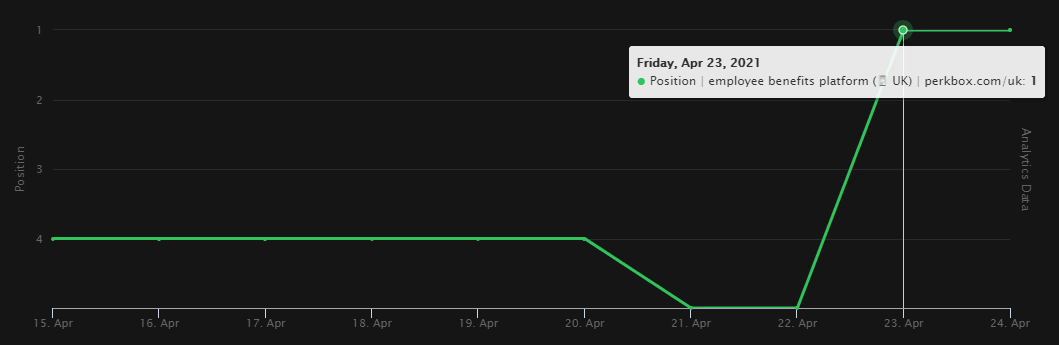
Rank tracking screenshot from Nightwatch
4. Conversion rate optimization (CRO)
Not every SEO provider includes CRO, but it’s worth considering — especially for clients with existing organic traffic. Increasing conversion rate on high-traffic pages can improve the organic channel KPI quickly without needing to rank for new keywords.
Look at: rewriting copy above the fold, testing CTA placement, adding social proof, improving page speed, and reviewing mobile experience. Start with site-wide changes (nav, footer, blog sidebar) for maximum impact before moving to individual pages.
Write case studies
Put yourself in the shoes of a prospective client. If you were spending money hiring an agency for a service you don’t fully understand, what would reassure you most?
Their track record. Real results for real clients in situations similar to yours.
Case studies are your most powerful sales asset. According to research by the Content Marketing Institute, case studies are consistently cited as one of the most effective B2B content formats for influencing purchase decisions. Make them specific, data-driven, and relevant to the prospect’s context.
What to include in a strong SEO case study:
- The client: who they are, what they do, their size
- The challenge: be specific — e.g. “needed to grow non-brand organic MQLs in the UK and US market”
- Your strategy: which tactics you used and why — e.g. programmatic landing pages, competitor comparison content, technical audit fixes
- The outcome: quantified results with timeframes — e.g. “organic sessions grew 140% in 6 months; demo bookings from organic increased 3x”
Aim to have at least one case study for each ICP segment you target (local, e-commerce, SaaS). If you don’t have them yet, prioritize building them with early clients — even at a reduced rate — specifically to generate the data.
Write an SEO service proposal
Everything you’ve gathered so far — research, discovery questions, quick wins, pricing, case studies — comes together in your proposal. A well-structured proposal dramatically increases your close rate by reducing uncertainty and demonstrating professionalism.
What to include in your SEO proposal
1. A high-level view of your strategy
You don’t need to reveal your entire playbook, but you need to demonstrate that you have one. Show examples of: technical issues you’ve identified on their site, content opportunities and keywords you’ll pursue, and link building strategies relevant to their niche. Walk through the 3–6–12 month plan at a high level.
2. Estimated impact
This is the hardest section to write, but also the most important. Based on the keyword opportunities you’ve identified, what’s the realistic traffic and revenue potential?
Break it into milestones: 3 months, 6 months, 12 months. Use your rank tracking data and industry CTR benchmarks to build the model. Be explicit that these are projections, not guarantees — but make them specific and grounded in data.
Clients who receive a proposal with a revenue forecast are far more likely to sign than clients who receive a proposal with only a list of deliverables.
3. Resources needed
Beyond your fee, what does the client need to commit to? Typical client-side inputs include:
- Content approvals and internal reviews
- Developer time for technical changes
- Product team input for SaaS feature pages
- Access to Google Analytics, Search Console, and CMS
Being explicit about this prevents the “we didn’t know we had to do that” conversation at month two.
4. Estimated timelines
Give the client a clear view of what happens when. You don’t need day-by-day granularity — milestones and phases work well. Month 1: audit and setup. Months 2–3: technical fixes and initial content. Months 4–6: content scaling and link building. And so on.
5. Your case studies and testimonials
Include the most relevant ones — matched to the client’s business model and industry where possible. A SaaS client wants to see SaaS case studies, not local services case studies.
6. How you’ll collaborate
Set expectations clearly on:
- How tasks are tracked and managed (e.g. Notion, Asana, or a shared Google Sheet)
- Communication cadence (e.g. monthly check-in calls, shared Slack channel)
- Reporting: what you’ll report on, how often, and in what format. Share a sample report — ideally a white-label dashboard that shows ranking trends, traffic, and goal completions
7. Fees
Position your fee as an investment, not a cost. Restate the revenue model: “Based on our projections, achieving these rankings would generate approximately $X in organic revenue per month. Our fee is $Y/month. The expected payback period is Z months.”
If there’s a minimum term, state it clearly. If you offer a trial period or a pilot project option, mention it here.
What to avoid in your proposal
- Vague deliverables: “We will improve your SEO” tells the client nothing. Be specific.
- Jargon-heavy language: Write for the business owner, not for an SEO specialist.
- Unrealistic promises: Guaranteeing #1 rankings or specific traffic numbers destroys trust if you don’t deliver. Use projections with appropriate caveats.
- No differentiation: If your proposal looks like every other agency’s proposal, price becomes the only differentiator. Make it clear why you specifically are the right choice.
Frequently Asked Questions
How do you sell SEO services to clients?
Selling SEO services starts with leading on business outcomes, not technical jargon. Show prospects what first-page rankings are worth in terms of traffic and revenue, then back it up with an audit showing their current gaps. The most effective sales process: run a quick site audit and keyword gap analysis before the call, present 3–5 specific opportunities with traffic estimates, address the “how long will it take” objection honestly (3–6 months for most campaigns), and close with a clear deliverables list and reporting cadence. Use rank tracking data to demonstrate progress and retain clients long-term.
How do I convince a client that SEO is worth it?
Convert the ROI: find the average monthly search volume for your target keywords, estimate a realistic click-through rate at position 1 (roughly 25–30%), multiply by your client’s average lead or sale value. Then compare that to what they’re currently spending on paid ads for the same keywords. Most clients who pay $5–10 per click on Google Ads immediately see that first-page organic rankings — which drive free clicks indefinitely — are worth significant investment. Showing real competitor rankings makes it tangible: “Your competitor ranks #1 for this keyword and gets an estimated 500 visits/month from it for free.”
What’s the biggest objection when selling SEO?
“How long will it take?” is the most common objection, and the honest answer is 3–6 months for meaningful results on most campaigns, with 12+ months to fully realise the potential of a competitive keyword strategy. The key is setting this expectation upfront rather than over-promising. Show clients a roadmap with early milestones — technical fixes in month 1, first ranking movements by month 3, traffic growth by month 6 — so they see progress before the big results arrive. Monthly rank tracking reports showing position improvements are the best tool for retaining clients through the early phase.
What tools do I need to sell SEO?
To sell SEO effectively you need three types of tools: an audit tool to identify technical issues and quick wins before the pitch (Screaming Frog or Nightwatch’s site audit), a keyword research tool to quantify the opportunity (Semrush, Ahrefs, or Nightwatch), and a rank tracking tool to prove progress and retain clients after the sale (Nightwatch). Being able to show a prospect their current keyword rankings versus competitors — and quantify what moving from position 8 to position 1 would mean in traffic — is the single most persuasive element of an SEO pitch.
Summary
Selling SEO isn’t rocket science, but it does require preparation, confidence, and a client-first mindset.
Start by getting clear on what you’re selling and who your best-fit client is. Qualify hard before investing time in a proposal. Arm yourself with responses to common objections so you’re never caught flat-footed. Price confidently by framing every fee in terms of the revenue it’s expected to generate.
Use rank tracking data to make your proposals concrete, and build reporting processes that keep clients engaged and informed throughout the engagement. Clients who can see progress stay — and clients who stay become case studies that win you the next client.
If you’re serious about building a successful SEO agency or scaling an existing one, the sales process is as important as the delivery. Get both right and you have a compounding business.
Good luck.