Keyword Cannibalization vs Content Cannibalization: What’s the Real Difference?
Quick Takeaways
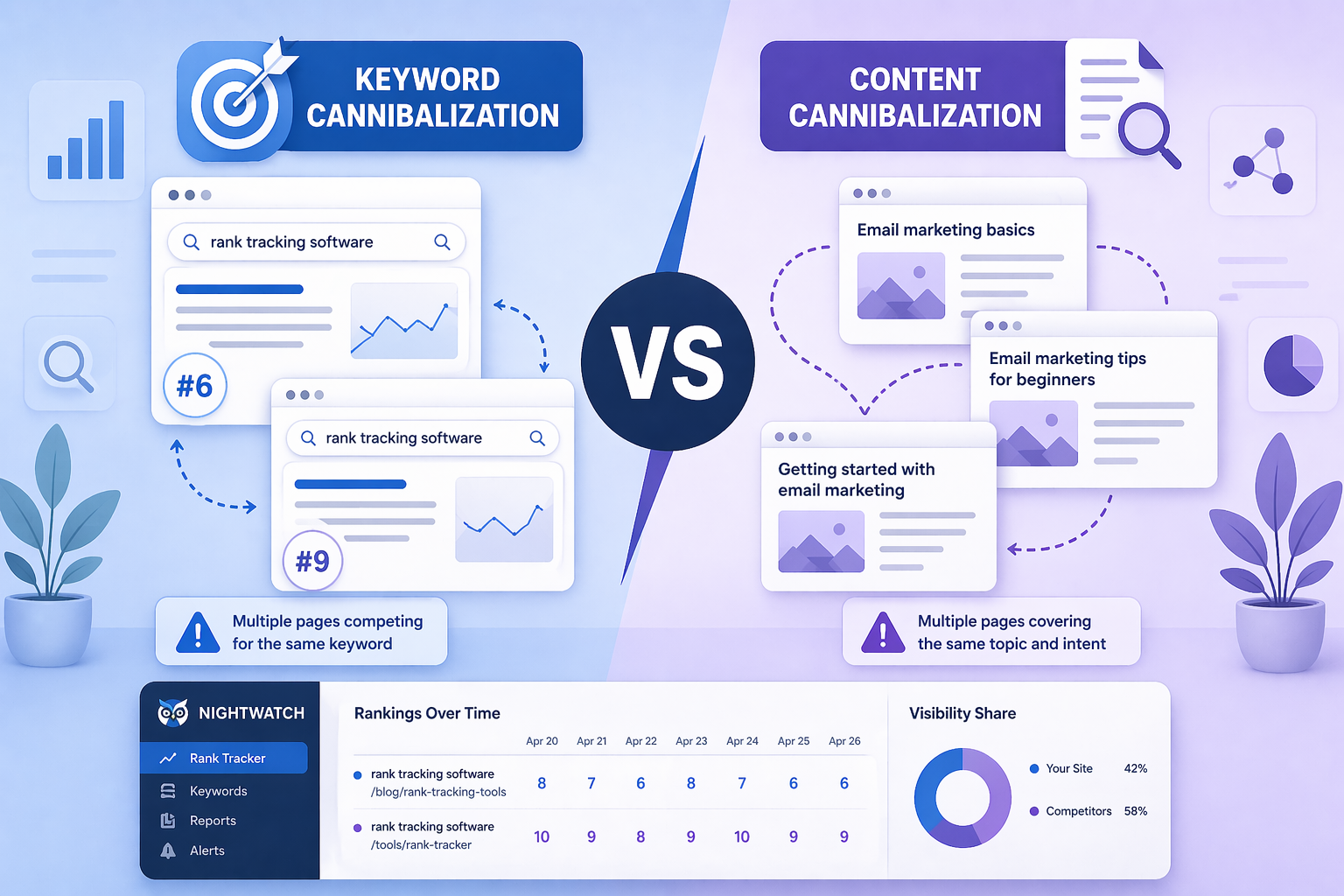
- Keyword cannibalization means multiple pages on your site compete for the same search term
- Content cannibalization is broader: pages compete for the same topic and search intent, even if the keywords differ
- You can have keyword overlap without content cannibalization, and vice versa
- Treating them as the same problem leads to the wrong fix
- Nightwatch’s Rank Tracker surfaces competing URLs early, before ranking damage compounds
Introduction
You’ve been publishing consistently. The content library is growing. Then you pull up Google Search Console and notice something odd: two of your own URLs are swapping positions for the same keyword, week after week. Neither breaks into the top five. Neither converts.
That’s not a traffic problem or a content quality problem. That’s a cannibalization problem.
Most SEOs use “keyword cannibalization” and “content cannibalization” as if they mean the same thing. They don’t. The distinction is small but it matters, because each problem has a different root cause and needs a different fix. Calling them both “cannibalization” and applying a generic solution is how sites end up consolidating pages that didn’t need merging, or leaving real intent overlap untouched because the keywords looked different on the surface.
This article breaks down exactly how the two terms differ, how to tell which one you’re dealing with, and what to actually do about it.
What is keyword cannibalization?
Keyword cannibalization happens when two or more pages on the same site target the same keyword and satisfy the same search intent. Google sees both pages as viable answers to the same query and has to pick one. Instead of backing your strongest page, it splits ranking signals between them. It may rank one page, then the other, depending on the crawl cycle.
The result: neither page ranks as well as a single, consolidated page would.
What actually triggers it
The phrase “same keyword” often gets over-simplified. Two pages don’t need identical title tags to cannibalise each other. A post titled “SEO tips for small businesses” and one titled “SEO best practices for small businesses” are targeting different phrases but likely serving the same intent. Google treats intent as the deciding factor, not exact keyword match.
Keyword cannibalization becomes a problem specifically when:
- Multiple pages target the same primary keyword
- Those pages serve the same search intent (both informational, both transactional, etc.)
- Neither page has a clear on-page or backlink advantage over the other
Search Engine Land’s keyword cannibalization guide frames it well: having more than one page rank isn’t automatically a problem. It becomes one when those pages fail to serve distinct user needs or dilute your authority.
When keyword overlap is fine
Not every instance of two pages sharing a keyword is worth fixing. If a product page and a blog post both mention “rank tracking software,” but one targets buyers (“best rank tracking software”) and the other targets researchers (“how rank tracking software works”), they’re serving different intents. They’re not competing. They’re complementary.
The test is simple: if a user searching that term would be equally satisfied by either page, you have a problem. If they’d clearly want one over the other, you don’t.
What is content cannibalization?
Content cannibalization is the broader version of the problem. Two pages can have completely different keywords and still cannibalise each other if they cover the same topic and satisfy the same underlying search intent.
This is the harder one to catch because keyword tools won’t flag it. You’re not looking for overlapping phrases. You’re looking for overlapping purpose.
Take three posts: “Email marketing basics,” “Email marketing tips for beginners,” and “Getting started with email marketing.” None share a primary keyword. But all three are answering the same question for the same type of reader. From Google’s perspective, they compete. The link equity and authority that should consolidate into one authoritative guide gets split three ways instead.
For a full breakdown of content cannibalization and how to resolve it, see Nightwatch’s existing guide on what content cannibalization is and how to fix it.
The short version: content cannibalization is harder to detect, tends to compound over time, and is often the underlying cause of the keyword cannibalization you can see in Search Console.
Keyword cannibalization vs content cannibalization: side by side
| Keyword cannibalization | Content cannibalization | |
|---|---|---|
| Definition | Multiple pages target the same keyword | Multiple pages cover the same topic and intent |
| Primary cause | Duplicate or near-duplicate keyword targeting | Overlapping content scope without clear differentiation |
| How to detect | Google Search Console query data; rank tracking | Content audit; topical overlap review |
| Ranking impact | Unstable rankings; pages rotating for same term | Diluted authority; neither page builds strong topical signals |
| Fix | Consolidate, canonicalise, or differentiate intent | Merge pages, redirect, restructure internal linking |
| Scope | Narrower — keyword-level overlap | Broader — can exist even without keyword overlap |
The key relationship: content cannibalization is the parent problem. Keyword cannibalization is often a symptom of it. When you fix content cannibalization properly, keyword cannibalization usually resolves with it.
How do you know which problem you have?
Check for keyword cannibalization in Google Search Console
Go to Performance and filter by a keyword you suspect is cannibalised. Click into the Pages tab. If you see two or more URLs receiving impressions for the same query, you have keyword overlap at minimum.
Look specifically at:
- Whether one URL is consistently ranking higher than the other
- Whether click-through rate has dropped on what should be your primary page
- Whether rankings for that term have been volatile over the past 30-90 days
If rankings are stable and one page is clearly winning, it may not need fixing. If they’re rotating or both stuck outside the top five, that’s worth investigating.
Use Nightwatch’s Rank Tracker to spot competing URLs
Google Search Console gives you a snapshot. Nightwatch gives you a timeline.
Here’s how to use it to catch cannibalization early:
- Step 1: In your Nightwatch dashboard, navigate to the Rank Tracker and open the keyword you’re investigating.
- Step 2: Check the ranking history for that keyword. Nightwatch tracks daily positions across all your monitored URLs. If two of your pages have been trading rankings for the same term, the position history will show it clearly.
- Step 3: Use keyword segmentation (Views) to group terms by intent: transactional, informational, commercial. If two pages in the same intent group are both targeting a term and neither is consistently in the top five, that’s a strong signal of cannibalization.
Nightwatch’s Rank Tracker also surfaces SERP features like Featured Snippets and local packs, so you can see if a cannibalised page is also blocking you from owning a feature you could win outright.
Get started with Nightwatch’s rank tracking to build this visibility into your regular workflow.
Spot content cannibalization through a topic audit
Keyword data alone won’t catch content cannibalization. You need to look at your content’s purpose, not just its target terms.
Pull a list of your blog posts and group them by topic. For each group, ask: if a reader landed on any one of these pages, would they still want to read the others? If the answer is no, those pages are likely cannibalising each other.
A content gap analysis is a useful complement here: it helps you see not just where you’re overlapping, but where your topical coverage has real holes worth filling instead.
Check your internal linking structure at the same time. If you’re linking to three different pages when a reader searches for the same topic, that’s often a structural signal that content has drifted into overlap.
How do you fix each one?
Fixing keyword cannibalization
You have three main options, and which one fits depends on how the competing pages relate to each other.
- Consolidate. If both pages cover the same topic with the same intent, merge them into one. Take the stronger-performing URL as your primary. Pull the best content from the weaker page into it. Set a 301 redirect from the old URL to the new one. This passes link equity to a single page and gives Google one clear signal.
- Canonicalise. If both pages need to exist (product variants, location pages, etc.) but they share too much content, use a canonical tag to tell Google which version is primary. This is more of a technical fix than a content fix.
- Differentiate intent. If the pages are genuinely covering different things but targeting similar phrases, the fix is repositioning rather than merging. Reoptimize one page for a related but distinct keyword. Adjust the angle so the two pages clearly serve different reader needs. When you do this, update your SEO competitor analysis to confirm the revised keyword has the right intent profile before committing.
For a data-driven view of which of your pages are competing, improving your content’s SEO performance starts with knowing what you have and what’s overlapping.
Fixing content cannibalization
Content cannibalization usually needs a merge-and-redirect approach. The goal is to create one page that covers the topic thoroughly, then redirect all the weaker versions to it.
When you merge:
- Pick the URL with the strongest backlink profile and ranking history
- Bring across any unique data, examples, or sections from the pages you’re retiring
- Set 301 redirects from the old URLs to the consolidated page
- Update all internal links that pointed to the old URLs
One thing most guides skip: don’t just delete the internal links to the redirected pages. Update them to point directly to the new consolidated URL. Redirect chains add crawl overhead and weaken the link signal over time.
For building a clean content structure that prevents future overlap, topic cluster optimization is worth reading alongside this.
When you don’t need to fix anything
Not every case of two pages ranking for the same query is a problem. If both pages are in the top five, serving slightly different intents, and you’re capturing multiple SERP positions, leave it alone. The goal is to avoid unnecessary consolidation as much as it is to catch real cannibalization.
The SEO monitoring playbook has a useful framework for distinguishing issues worth acting on from noise worth monitoring.
How to prevent both going forward
Map keywords to pages before you publish
Most cannibalization is accidental. A writer picks a keyword that looked uncovered. An editor commissions a refresh that ends up too close to an existing post. A category page gradually accumulates enough content to compete with the blog.
The fix is a content ownership map: a simple spreadsheet where each page has a primary keyword, a clear intent, and no overlap with any other page in the same intent group. Before any new content goes live, check it against what you already have.
Building this habit into your keyword clustering process is the most efficient way to do it. Group keywords by topic and intent first. Assign one page per group. Any new piece of content that doesn’t have a clear, unoccupied group probably shouldn’t be written yet.
Run regular audits with rank tracking data
Keyword maps drift. Content gets refreshed. Topics evolve. A page that was clearly differentiated eighteen months ago can start competing with a newer post after a few rounds of updates.
Running a quarterly check using Nightwatch’s rank tracking data is the most reliable way to catch drift before it compounds. Filter your keyword list by pages that have dropped in ranking over the past 90 days. If a drop coincides with a new piece of content going live on a similar topic, you’ve found your cannibalization source.
NightOwl, Nightwatch’s AI SEO agent, can also help here. Its keyword clustering and site audit features surface structural issues automatically, including pages that are competing for the same terms. Rather than waiting for rankings to drop, head to NightOwl and run a site audit to get ahead of overlap before it affects performance.
Frequently asked questions
Is keyword cannibalization the same as duplicate content?
No. Duplicate content means two pages have identical or near-identical text. Keyword cannibalization means two pages compete for the same search intent, but the content itself can be completely different. You can have pages that are written entirely independently and still cannibalise each other if they target the same query and serve the same purpose. The fixes are also different: duplicate content is usually resolved with canonical tags or noindex, while keyword cannibalization typically needs content consolidation or intent differentiation.
Does keyword cannibalization always hurt rankings?
Not always. If two of your pages rank in positions two and four for the same term, you’re capturing significant share of voice and the pages serve different angles. The problem appears when pages are rotating outside the top five, when click-through rates are declining on your primary page, or when neither page is building authority because signals are split. Use rank tracking data to assess impact rather than treating any overlap as automatically problematic.
How long does it take to recover after fixing cannibalization?
Most sites see measurable change within two to six weeks after implementing 301 redirects, page merges, or re-optimization. Larger sites with extensive crawl queues can take longer, simply because Google needs more time to process the changes. Monitoring your rank tracking data weekly after a fix gives you a clear signal of whether the consolidation is having the intended effect.
Can I have content cannibalization without keyword cannibalization?
Yes, and this is exactly why the distinction matters. Two pages targeting different keywords can still cannibalise each other if they answer the same underlying question for the same type of reader. A post on “how to track keyword rankings” and one on “monitoring your search positions” are targeting different phrases, but Google may treat them as competing answers to the same intent. A content audit that looks at topic and purpose, not just keyword overlap, is the only reliable way to catch this.
Should I worry about cannibalization on a small site?
Small sites are less likely to have severe cannibalization problems simply because they have fewer pages. That said, the habit of mapping keywords to pages before publishing is worth building early. It’s much easier to maintain clean content architecture from the start than to untangle a large library later. A basic content ownership map and quarterly rank tracking check is enough for most small sites.
Keyword cannibalization vs content cannibalization: get the diagnosis right first
Keyword cannibalization and content cannibalization describe related but distinct problems. Keyword cannibalization is visible in your rank tracking data: competing URLs for the same term. Content cannibalization is harder to see because it doesn’t require keyword overlap. It’s about pages competing on intent.
Getting the diagnosis right matters because the fixes are different. Merging pages that don’t need merging wastes editorial time. Leaving real intent overlap untouched lets ranking signals dilute indefinitely.
Start by checking your rank tracking data for keywords where multiple URLs are trading positions. Then run a topic-level content audit to catch the cases keyword data won’t surface. If you want a faster way to do both, start a free Nightwatch trial and use the Rank Tracker to see exactly which of your pages are competing with each other.