
How to Scale an SEO Agency Without Hiring More People
Quick Takeaways
- Adding clients without adding headcount is a systems problem, not a talent problem
- The agencies that scale fastest treat their tool stack as a second team
- Agentic AI now handles multi-step operations that previously needed a dedicated person
- LLM visibility tracking is a standard client deliverable; agencies without it are losing pitches
- White-label reporting done right is one of the highest-leverage retention tools an agency has
Introduction
Most agency owners hire when they get busy. The ones that scale do it as a last resort, only after they’ve removed every inefficiency from how work gets done.
The question worth asking before any hire is: how much of what your team does right now could run differently with better systems? For most agencies, the answer is more than they’d expect — and the gap shows up first in where the hours actually go, what a genuinely scalable delivery model looks like, and where agentic AI has changed the math enough to matter.
Table of Contents
- Why Agency Growth Stalls
- What Scaling Actually Looks Like
- Build Your Delivery Systems Before You Need Them
- Agentic AI: When the Tool Runs the Workflow
- Tracking at Scale: Rank and AI Visibility Across Your Full Client Roster
- Reporting as a Retention Tool, Not an Admin Task
- Link Building: Still Manual, But Systems Reduce the Drag
- What Still Needs a Human
- How Do You Know It’s Working?
- Where to Focus First
- Frequently Asked Questions
Why agency growth stalls
Scaling and growing are two different things. Growing means more clients and more revenue. Scaling means more clients and more revenue with costs that don’t rise at the same rate. Most agencies grow. Fewer actually scale.
The linear model
The reason growth stalls at most agencies: delivery is built around people, not systems. When a new client comes in, someone has to set up tracking, pull data, write reports, manage communications, and execute the work. Each of those tasks takes roughly the same amount of time regardless of how many clients came before it.
That model has a ceiling. Once your team is full, you either turn down work, reduce quality, or hire. None of those options improve the business.
Where the hours actually go
Most of the work in an SEO agency falls into a handful of functions. Some of those functions scale with the right systems in place. Others require skilled human judgment no matter how good your tools are.
| Agency function | Avg. hours per client per month | Scales with automation? |
|---|---|---|
| Rank tracking and monitoring | 3-5 hrs | Yes |
| Client reporting | 4-10 hrs | Yes |
| Technical site audits | 3-6 hrs | Yes |
| Keyword research and clustering | 4-8 hrs | Partial |
| Content briefs and strategy | 3-5 hrs | Partial |
| Content writing and editing | 20-40 hrs (which scale with volume) | Partial |
| Link building and outreach | 5-10 hrs | No |
| Client strategy and comms | 3-6 hrs | No |
For a 15-client agency, that adds up to somewhere between 300 and 600 hours a month in work that is either fully automatable or could be significantly reduced with better tooling. That’s the equivalent of four to five full-time employees, depending on how manual your current setup is.
What scaling actually looks like
A scaling agency and a busy agency look similar from the outside. Both are winning clients. The difference shows up in the numbers.
The metric that matters
Revenue per team member is a better indicator of whether an agency is scaling than total revenue. If you’re adding clients and revenue per person is flat or falling, you’re growing, not scaling. If revenue per person is rising as you add clients, your systems are working.
Client-to-headcount ratios
There’s no universal benchmark here, but a well-systemized agency running primarily SEO retainers should be handling five to eight clients per full-time team member. Agencies that rely heavily on manual workflows tend to top out at three to four. The gap between those two numbers is mostly process.
Revenue per team member
Agencies with well-systemized delivery tend to generate significantly more revenue per team member than those relying on manual workflows. The gap typically reflects how much billable capacity is consumed by operational work that doesn’t require skill — and that gap widens as client count grows.
Build your delivery systems before you need them
Most agencies build systems reactively. A client complains about inconsistent reporting, so a template gets made. Someone leaves and onboarding a replacement takes two months because nothing was documented. A new client comes in and setup takes three weeks because the process only exists in one person’s head.
Building systems proactively, before the pressure hits, is one of the highest-leverage things an agency owner can do.
Standardize before you automate
Automation only works on processes that are already consistent. If every account manager formats reports differently, or if keyword research starts from scratch with each new client, automating those tasks isn’t possible. The first step is standardizing: define what a report looks like, what a technical audit covers, how a new client gets set up. Once that’s consistent, the repetitive parts can be automated.
The compounding return on systems work
One hour spent building a repeatable workflow pays back roughly ten hours over the course of a six-month retainer. Across a 15-client roster, that arithmetic becomes significant quickly. Agencies that invest in systems early are making each hour count more. You can read more about building a successful SEO agency and the operational decisions that separate growing agencies from ones that stall.
What good delivery infrastructure looks like
At minimum, a well-systemized SEO agency has:
- A defined onboarding checklist that can be handed to any team member
- Templated reporting that pulls from tracked data, not manual exports
- A clear scope-of-work for each service tier, so delivery doesn’t expand arbitrarily
- A single place to monitor SEO performance across all clients, without logging into separate tools for each account
That last point is where most agencies lose the most time.
Agentic AI: when the tool runs the workflow
Before getting into specific functions: agentic AI is a meaningful shift from earlier automation, not just faster scheduling — and understanding what it changes affects which tools you actually invest in.
What agentic means in practice
Standard AI tools respond to prompts. You ask a question, you get an answer. Agentic AI works differently. An agentic system can receive a goal, break it into steps, execute those steps using whatever tools are available, evaluate the output, and return a completed result, without being prompted at each stage.
According to MIT Sloan, AI agents can “execute multi-step plans, use external tools, and interact with digital environments to function as powerful components within larger workflows.” A McKinsey analysis found that a human team of two to five people can already supervise an agent system running end-to-end processes that would previously have required a much larger group.
What that looks like for an SEO agency
Tools like NightOwl can operate agentically across an SEO workflow. Given a topic, an agentic setup can research competitor content, identify keyword gaps, draft a content brief, flag technical issues on the target page, and return a finished output as a single operation. No one has to initiate each step. The strategist reviews the output, not the process.
Rather than waiting to be asked, it monitors rankings, surfaces opportunities, runs keyword research, and conducts technical audits autonomously. An account manager can check NightOwl’s output each morning and act on what it surfaces, rather than spending hours pulling that data themselves.
That’s a practical example of the staffing implication: one strategist overseeing work that previously needed two or three people to initiate and manage. If you want a broader view of what AI SEO agents can do in this context, the best AI SEO tools for agencies breakdown covers this in more detail.
Tracking at scale: rank and AI visibility across your full client roster
Rank tracking is one of the first things that breaks as an agency grows. With five clients, checking positions manually is tedious but manageable. With 15 or 20, it becomes a job in itself, producing inconsistent data and takes time away from the work that actually moves results.
What agencies actually need from a rank tracker
Most rank trackers give you a dashboard. What agencies need is something that works across a full client roster without requiring someone to log in, export, and interpret data for each account. That means:
- Accurate location-level tracking, not just country-level averages
- Multi-client management from a single view
- Automated alerts when rankings shift significantly
- Enough location depth to handle local SEO clients properly
Nightwatch tracks keywords across 190,000 locations down to ZIP code level, across all major search engines and devices. For agencies with local clients, that level of granularity means you’re not approximating performance. You’re seeing what your clients’ customers actually see. More context on what to look for in a rank tracker: best rank tracking tools for agencies.
Why AI visibility is now part of the pitch
According to research from Slate HQ, AI Overviews now appear in 30% of Google searches, and the resulting shift has driven a 40% drop in traditional organic clicks for affected queries. Meanwhile, tools like ChatGPT and Perplexity have become primary discovery channels for a significant portion of users.
Clients are already asking whether they appear in AI-generated answers. Agencies that can’t answer that question, or can’t show movement on it over time, are going to struggle to retain those accounts. AI visibility tracking is moving from a differentiator to a basic expectation, much like rank tracking did a decade ago.
You can get up to speed on the tools available for this in our LLM tracking tools guide.
One dashboard for both
Nightwatch’s AI and LLM Tracker tracks brand mentions, share of voice, sentiment, and average position across ChatGPT, Perplexity, Google AI Mode, and AI Overviews. Combined with the Rank Tracker, it gives agencies a single place to monitor traditional rankings and AI visibility across every client.
Setting it up across a client roster looks like this:
-
Step 1: In your Nightwatch dashboard, create a separate project for each client
-
Step 2: Add the client’s target keywords to the Rank Tracker with the relevant locations, devices, and search engines
-
Step 3: In the AI and LLM Tracker, set up the prompts relevant to that client’s industry and brand
-
Step 4: Configure alert thresholds for significant ranking changes or drops in AI visibility
-
Step 5: Review the combined dashboard daily or set up automated digests per client
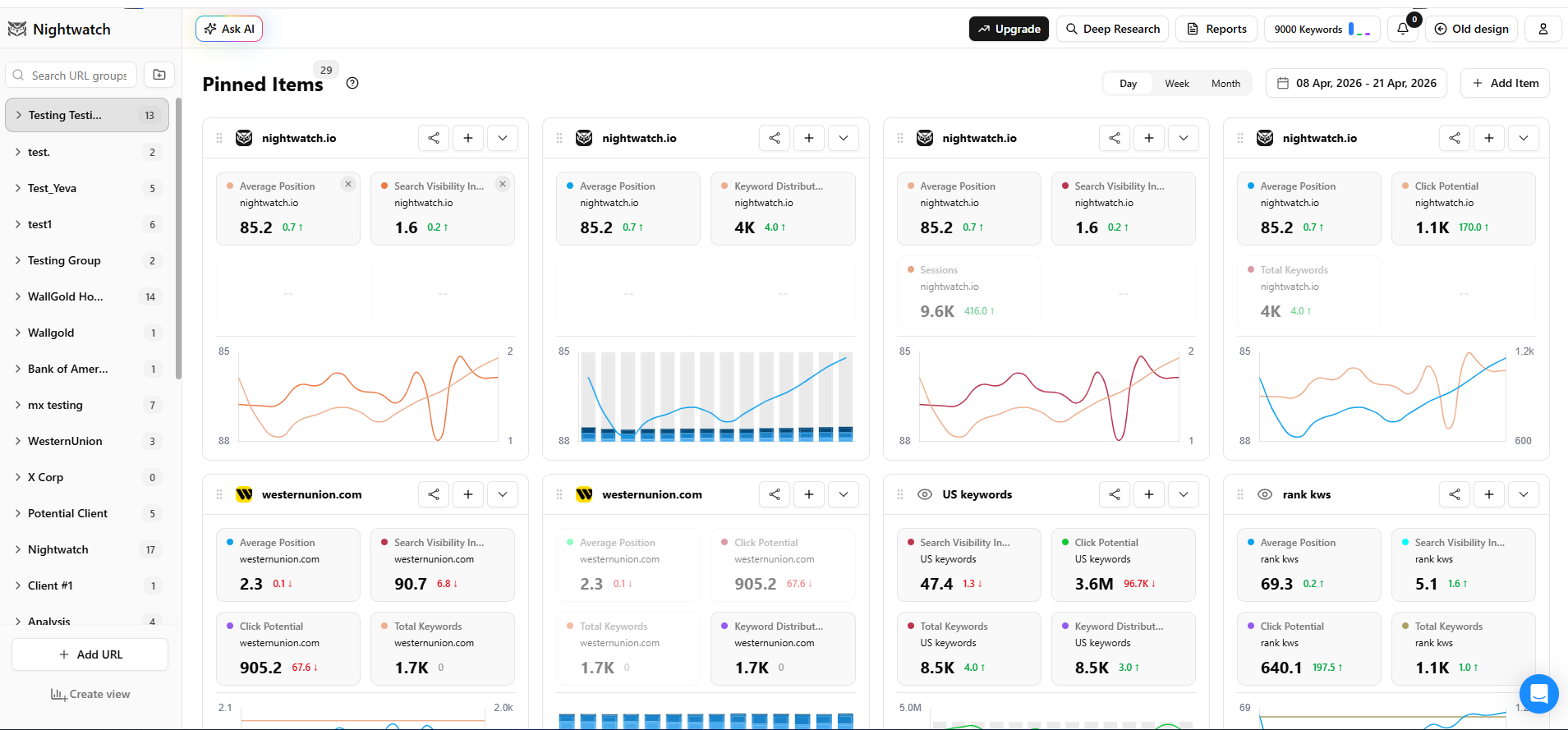
From that point, monitoring a 20-client roster takes minutes a day rather than hours, because the data comes to you instead of requiring manual collection.
Reporting as a retention tool, not an admin task
What reporting actually does for retention
A report is the primary way most clients understand the value of what they’re paying for. A Hello Bonsai client satisfaction report found that 72% of clients rate regular, clear updates as a key factor in their satisfaction with agencies.
The inverse is also true. Confusing reports, or reports that arrive with a third-party tool’s branding plastered across them, erode confidence. Every report that carries someone else’s logo tells your client, at least subconsciously, that your agency is reselling another company’s output rather than delivering its own expertise.
White-label reporting fixes this. Your logo, your brand colors, your agency’s name on the results. The client sees your agency’s analysis, not your tech stack.
What a good report actually communicates
Data without context doesn’t retain clients. A report that shows 47 keywords in the top 10 is less useful than one that says which keywords moved, what changed on the page, and what that means for the client’s pipeline. The best-performing agencies connect rankings and AI visibility data to business outcomes: leads, traffic quality, conversion trends, not just position numbers.
The monthly SEO report template covers the specific components worth including. For a broader look at how reporting fits into performance tracking, the SEO reports and analysis guide is useful context.
Setting up automated, branded reporting in Nightwatch
Nightwatch’s white-label reporting lets you brand reports per client, automate scheduling, and deliver polished PDF or HTML reports without manual data pulling.
Here’s how to set it up across your roster:
Step 1: Go to the Reports section in Nightwatch and select a report template
Step 2: Upload your agency logo and set brand colors for that client’s workspace
Step 3: Add the data modules relevant to that client: rankings, AI visibility, traffic trends, competitor movements
Step 4: Set the delivery schedule: weekly, fortnightly, or monthly. and add the client’s email address
Step 5: Review the first report before it goes out, then let the system run it automatically from there
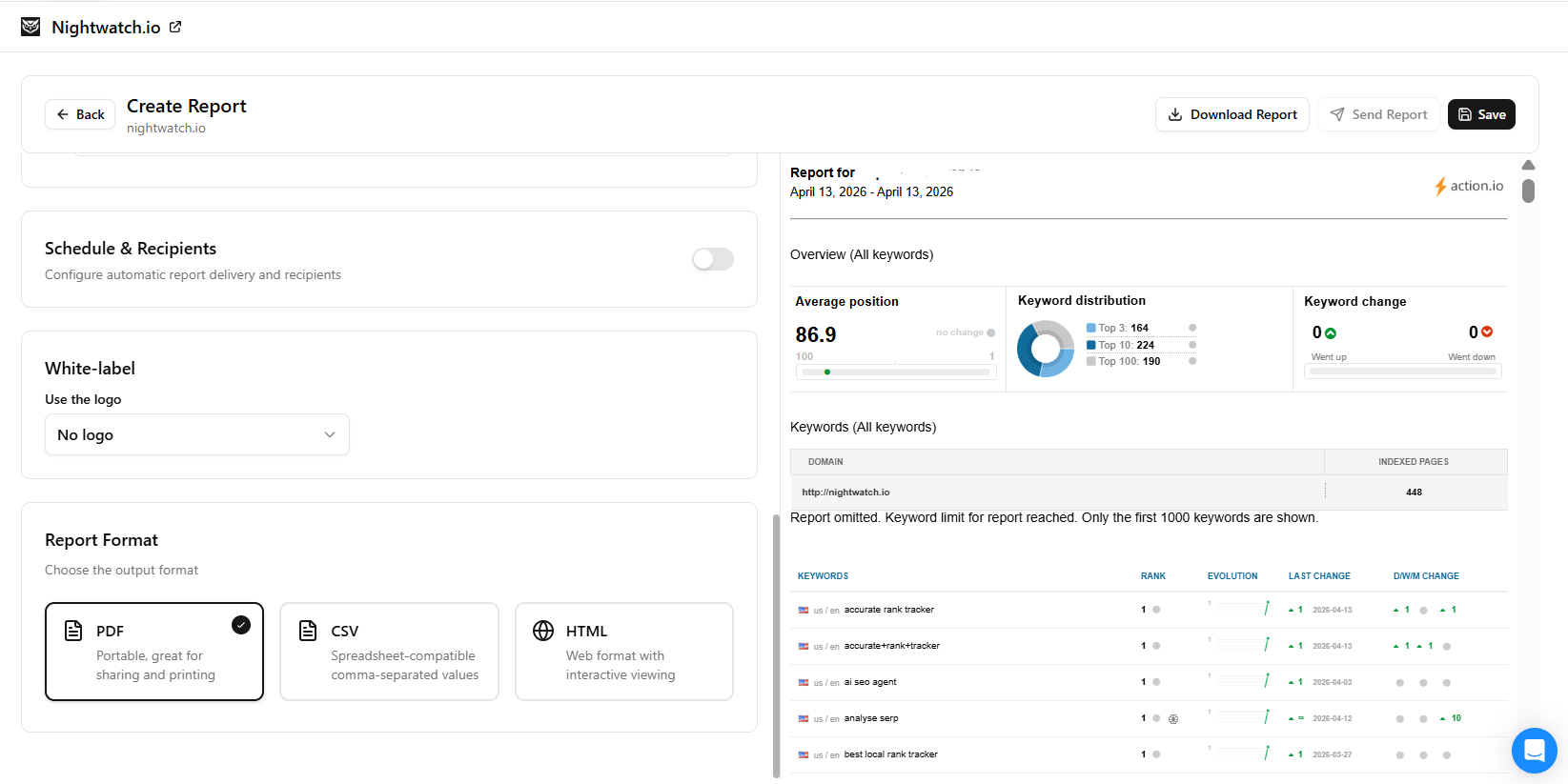
Once that’s configured for each client, reporting runs without anyone touching it. The hours previously spent on manual exports and formatting go back to billable work.
Link building: still manual, but systems reduce the drag
Link building is the one core SEO function that hasn’t been meaningfully automated. Outreach still requires a person. Editorial relationships still require trust. Placement decisions still require judgment about relevance and authority. That’s not changing soon.
What can be systematized is everything around it: prospecting lists, outreach templates, follow-up sequences, placement tracking, and reporting on link acquisition over time. That reduces the administrative drag on whoever is doing the outreach, even if the outreach itself stays human.
For agencies scaling link building across multiple clients, the practical approach is to separate the strategic and relationship work (which stays in-house) from the prospecting and administrative work (which can be handled by junior staff with good templates, or outsourced to a specialist). That split lets a senior link builder manage three to four times the number of active campaigns they could handle if they were doing everything themselves.
What still needs a human
Automation handles repetitive, data-driven work well. It doesn’t handle judgment, relationships, or creative thinking.
Client relationships and strategy
No tool replaces the account manager who understands a client’s business, their internal politics, their risk tolerance, and what they actually care about. Strategy requires context that only comes from sustained conversation. This is where experienced people generate the most value, and where most agencies should be concentrating their senior staff.
Content judgment
AI can generate a first draft. It can follow a brief. What it can’t reliably do is know whether a piece of content feels right for a specific brand, whether it addresses the real question a searcher has, or whether the tone is consistent with six months of previous writing. Editing, judgment calls, and final approval still require a human who knows the client.
Link building outreach
As covered above, relationship-based outreach can’t be handed to a tool. What changes with scale is how efficiently a person can do it, not whether a person is needed.
The practical split
The goal isn’t to remove humans from agency work. It’s to make sure skilled people are spending their time on the work that actually requires their skills, and that the rest is handled as efficiently as possible. For agencies that are thinking about how to position this shift to clients and prospects, how to sell SEO services is worth reading alongside your service positioning.
How do you know it’s working?
Revenue per team member
This is the clearest indicator. If it’s rising as you add clients, your systems are absorbing the new work efficiently. If it’s flat or falling, you’re adding operational complexity faster than you’re adding output. Well-systemized SEO agencies typically generate significantly more revenue per team member than those with manual workflows.
Client-to-headcount ratio
Track how many active clients each team member is responsible for across the full delivery cycle. If it’s below four or five, there’s room to improve through better systems. If it’s above eight and delivery quality is holding, the model is working.
Time-to-report and client churn rate
How long does it take from the end of a reporting period to a client receiving their report? If the answer is more than two days, the reporting process is still too manual. Client churn rate tells you whether delivery quality is holding up as you scale. Volume without retention isn’t growth. It’s a treadmill.
For more context on the numbers that matter in agency management, growing and scaling your digital marketing agency covers the business-level decisions that support these metrics.
Where to focus first
Scaling an SEO agency without proportionally growing headcount comes down to one question: where is your team spending time on work that could run automatically?
For most agencies, reporting and rank monitoring are the fastest wins. Setting up automated, white-label reporting and centralised tracking across your client roster through Nightwatch removes the two biggest sources of non-billable manual work before anything else. From there, agentic tools extend that capacity further, handling research, auditing, and monitoring tasks that previously needed someone to initiate and manage at each step.
The goal isn’t a leaner team. It’s a team whose time is concentrated on the work only they can do.
Try Nightwatch free and set up rank tracking, AI visibility monitoring, and white-label reporting across your full client roster.
Frequently asked questions
Can a small SEO agency scale without any automation tools?
Technically, yes. Practically, it becomes harder with every client you add. The time cost of manual tracking and reporting compounds quickly, and at a certain point it either limits how many clients you can take on or forces you to hire. Most small agencies that grow to 10 or more clients without automation tools end up in a cycle where they hire to cover the manual work, which reduces margins, which makes the business harder to run profitably. Starting with even basic automation (automated rank tracking and scheduled reporting) removes two of the biggest manual drains early.
What’s the difference between SEO automation and agentic AI?
SEO automation handles specific, repetitive tasks: scheduled reports, automated rank checks, site crawl alerts. Agentic AI goes further. It can take a goal, figure out the steps required to accomplish it, execute those steps across multiple tools, and return a completed result. The practical difference for an agency is that automation reduces manual effort on known tasks, while agentic AI can handle tasks that previously required human decision-making at each stage.
How many clients can one person realistically manage with the right systems?
It depends on the scope of services and the quality of the systems. For standard SEO retainers (rank tracking, content, reporting, basic technical work), a single account manager with solid automation in place can realistically handle five to eight clients. Without it, three to four is more typical. The ceiling rises further with agentic AI handling research, auditing, and monitoring tasks.
Is white-label reporting worth setting up for a small client roster?
Yes, earlier than most agencies expect. The time saving is meaningful even at five clients, and the professional presentation it produces has a real effect on client confidence and retention. Setting it up once and running it automatically is significantly less work than manually producing reports every month, regardless of roster size.
When should an agency actually hire?
When the work that can’t be automated (client strategy, relationships, content judgment, link building) is genuinely overloaded. If you’re hiring because reporting and tracking are taking too much time, systems are the better fix. If you’re hiring because the work that requires human skill and judgment has outgrown your current team’s capacity, that’s the right trigger.
Does tracking LLM visibility actually matter for most clients?
Increasingly, yes. The share of searches that return AI-generated answers is growing, and the traffic patterns from those results are different enough from traditional organic that clients need visibility into both. More importantly, it’s becoming a pitch differentiator. Agencies that can show AI visibility data alongside traditional rankings are demonstrating a more complete picture of search performance. Those that can’t are answering a narrower version of the question clients are starting to ask.