SEO and GEO in 2026: What 2,885 AI Answers Tell Us
Quick Takeaways
- There is no single “AI search” to optimize for. In Nightwatch’s tracking of 2,885 AI answers, ChatGPT and Google’s AI Overviews had only 8% of their cited sites in common for the same question.
- On Google, GEO is partly a video problem. 87% of Google AI Mode answers and 69% of AI Overviews cited at least one YouTube video. ChatGPT and Perplexity cited none.
- ChatGPT reads the toolmakers’ own sites. 19 of the 20 domains it cited most were companies’ own product and blog pages. Google’s AI leaned on videos, third-party roundups and Reddit instead.
- A single check is a snapshot, not a ranking. Between two consecutive checks of the same question, about a third of the cited sites changed.
- AI Overviews now show on about 2 in 5 searches and cut clicks by 40%. Two randomized experiments agree on the drop (Agarwal and Sen, Wang et al.). In our own 5,104 tracked keywords, comparison searches triggered them most (60.8%).
- llms.txt and “AI schema” have no measurable effect. Google says it doesn’t use them (Google Search Central).
Most “SEO is dead / SEO is fine” takes in 2026 pick one study and ignore the rest. This guide adds something they can’t: what Nightwatch sees when it asks ChatGPT, Perplexity and Google’s AI the same questions every day and records every source they cite. We combine that with the strongest independent research, grade each finding by how solid it is, and turn what survives into a playbook.
If you only have a minute, jump to what 2,885 AI answers show and the playbook.
Table of Contents
- The new shape of search: a four-step funnel
- AI Overviews now show on 2 in 5 searches
- What AI Overviews do to your clicks
- What 2,885 AI answers show about citations
- Ranking for one keyword isn’t enough anymore
- What makes a page worth citing
- What doesn’t work: llms.txt, AI schema and other shortcuts
- AI referral traffic: small, but worth more per visit
- The measurement gap
- The evidence scorecard
- The 2026 playbook: what to do, skip and measure
- FAQ
The new shape of search: a four-step funnel
For twenty years, organic search had one scoreboard: your position. Rank higher, get more clicks. In 2026 that scoreboard has split in two.
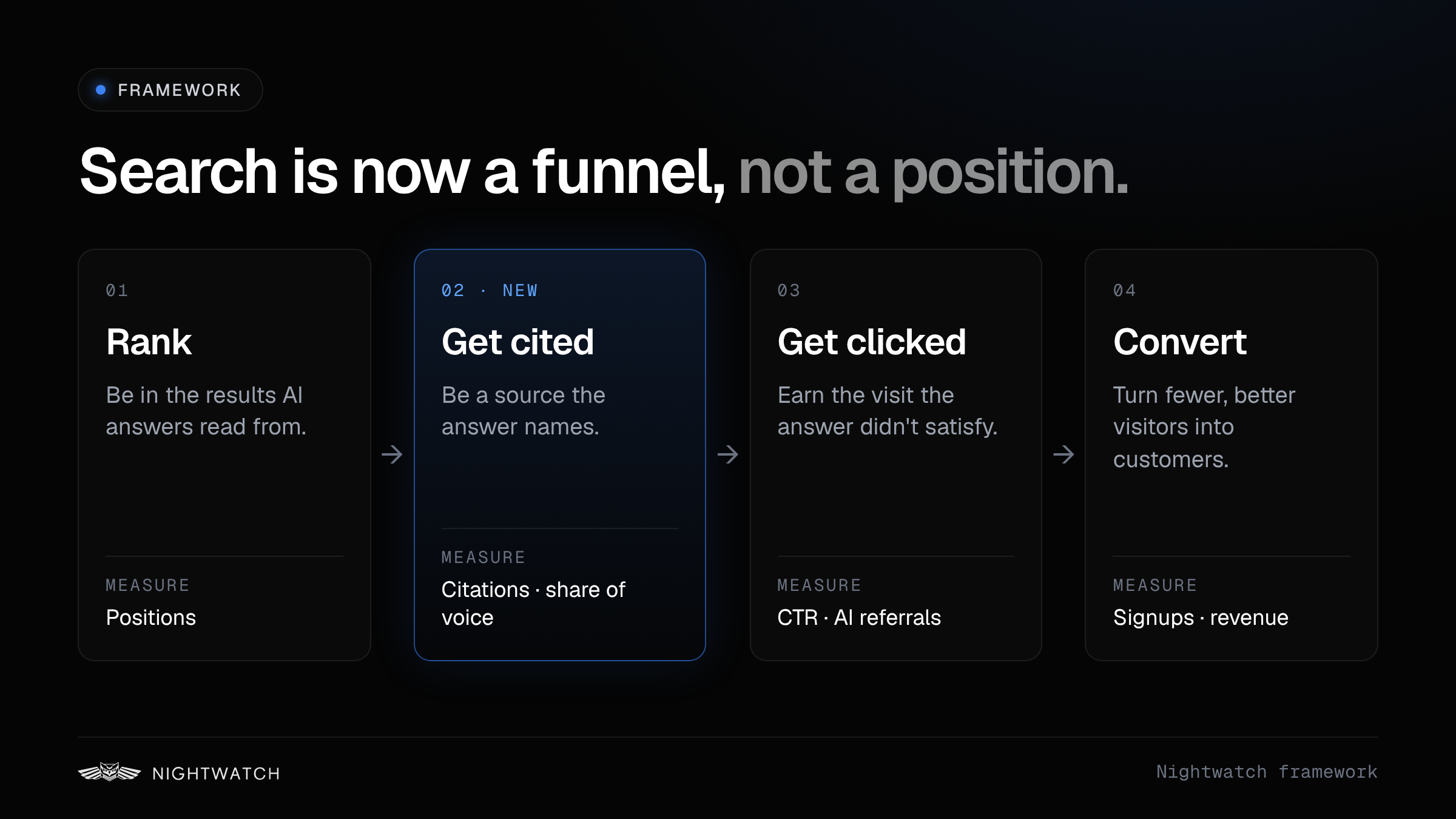
Every organic visit now passes through four steps:
- Rank. Your page has to be in the pool that Google, ChatGPT or Perplexity retrieves from. That pool includes the original query and the related sub-queries the AI runs in the background.
- Get cited. Out of that pool, the AI answer names or links a handful of sources. This step didn’t exist before, and it’s where most of the change is happening.
- Get clicked. A cited source still has to earn the visit the answer didn’t satisfy.
- Convert. Fewer visitors arrive, but they arrive better informed.
Most teams measure step 1 with a rank tracker and step 4 with analytics. Step 2 is the blind spot. That’s the core of what people now call GEO (generative engine optimization), and it’s why the GEO vs SEO debate is a false choice. You need both scoreboards, because one feeds the other.
The rest of this guide walks through the evidence for each step.
AI Overviews now show on 2 in 5 searches
Before anyone ranks, gets cited or gets clicked, Google decides whether to answer the question itself. Increasingly, it does.
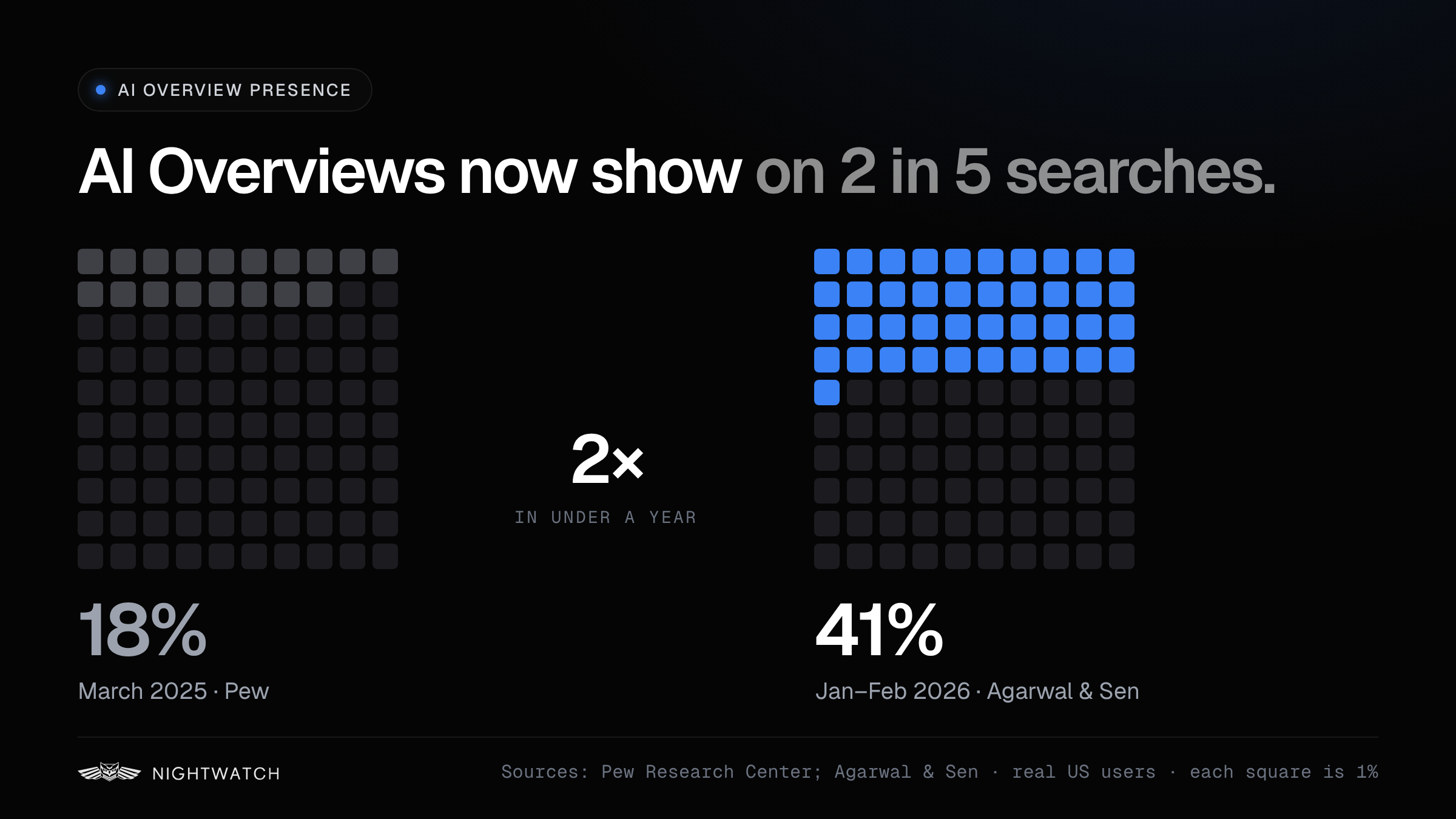
The most reliable numbers come from watching real people search, not from keyword lists:
- In March 2025, Pew Research Center tracked the browsing of US adults and found an AI summary on 18% of their Google searches.
- In January and February 2026, the Agarwal and Sen experiment logged 68,089 searches by 1,065 US users. Google tried to show an AI Overview on about 41% of them (PPC Land summary).
Keyword-level tracking shows the same climb, and higher. A 2026 industry panel that checks a large set of mostly US-English keywords every month found an AI Overview on 61.4% of them in August 2026, up from 5.9% two years earlier.1 Keyword lists over-represent informational queries, so that figure runs above what the average searcher sees.
What our own keywords show
Nightwatch tracks 5,104 keywords for nightwatch.io on Google in the US (desktop), mostly about SEO tools, rank tracking and keyword research. In the latest daily check, between November 21 and 25, 2026, 43.8% of them (2,234 keywords) showed an AI Overview. That’s close to the 41% real users saw in the Agarwal and Sen experiment, measured in a completely different way.
The more interesting part is which searches get one:
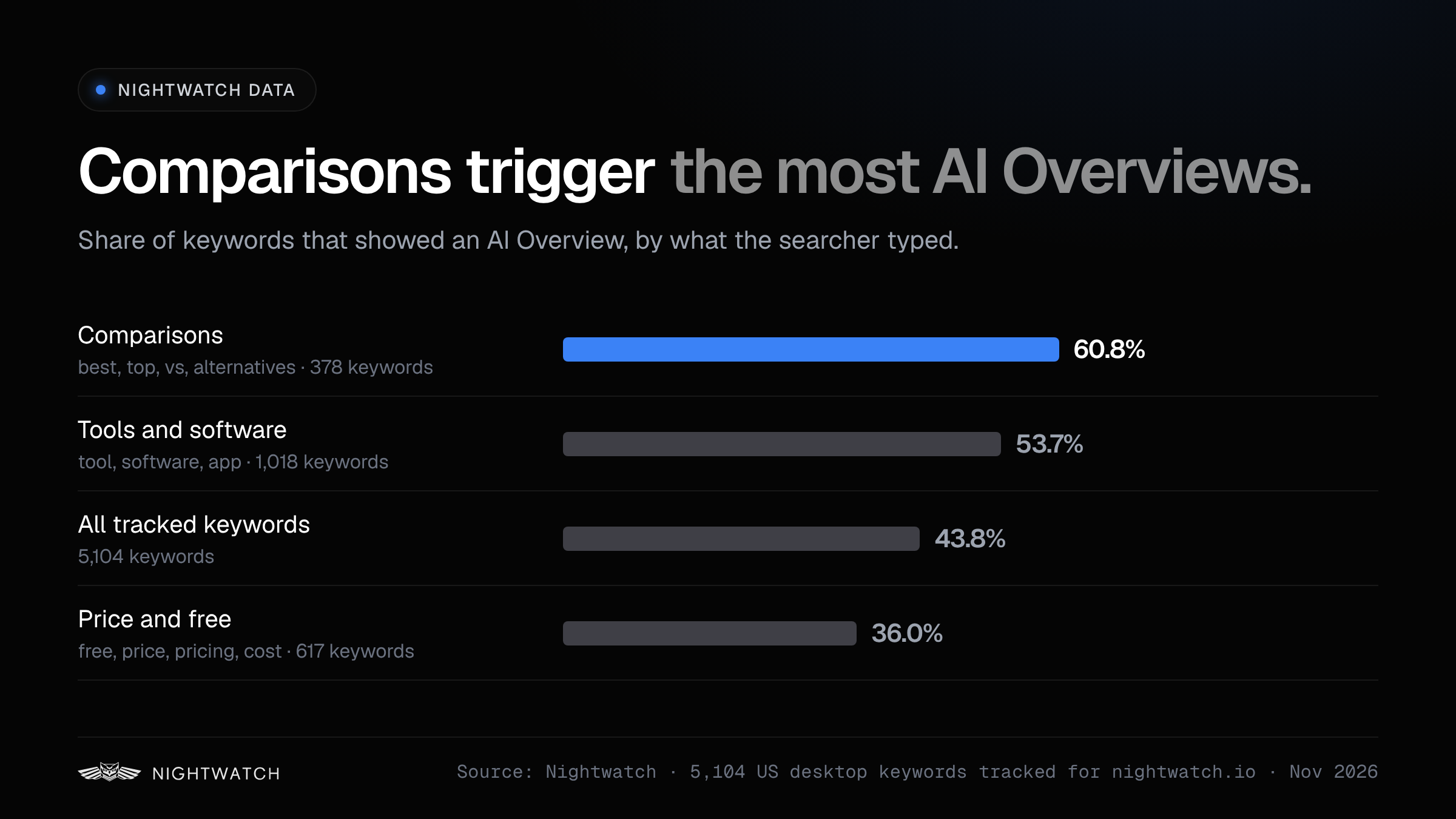
- Comparison searches (containing best, top, vs, versus, alternative, alternatives, compare or comparison): 60.8% of 378 keywords.
- Tool and software searches (tool, tools, software or app): 53.7% of 1,018 keywords.
- Price and free searches (free, price, pricing, cost, cheap or cheapest): 36.0% of 617 keywords.
Groups match whole words, so “best free rank tracker” counts in two of them. It’s one keyword set in one niche, so read it as a sample, not an industry benchmark. But the pattern is worth acting on: the “best X for Y” and “X vs Y” searches buyers run just before they choose are exactly where Google most often answers first.
The two user studies used different panels, so read the jump as a direction rather than a precise growth rate. The direction is clear: in under a year, AI Overviews went from an occasional feature to something a typical searcher sees on two searches in five.
What this means for you: “Does my keyword trigger an AI Overview?” is no longer an edge case. Track it per keyword, starting with your comparison keywords. Nightwatch’s AI Overview tracking flags which of your tracked keywords show an Overview and whether you’re cited in it. For a deeper primer on how Overviews pick and show sources, see our guide to AI Overviews.
What AI Overviews do to your clicks
This is the question that matters most, and in 2026 it finally has causal evidence instead of just correlations.
The randomized experiment
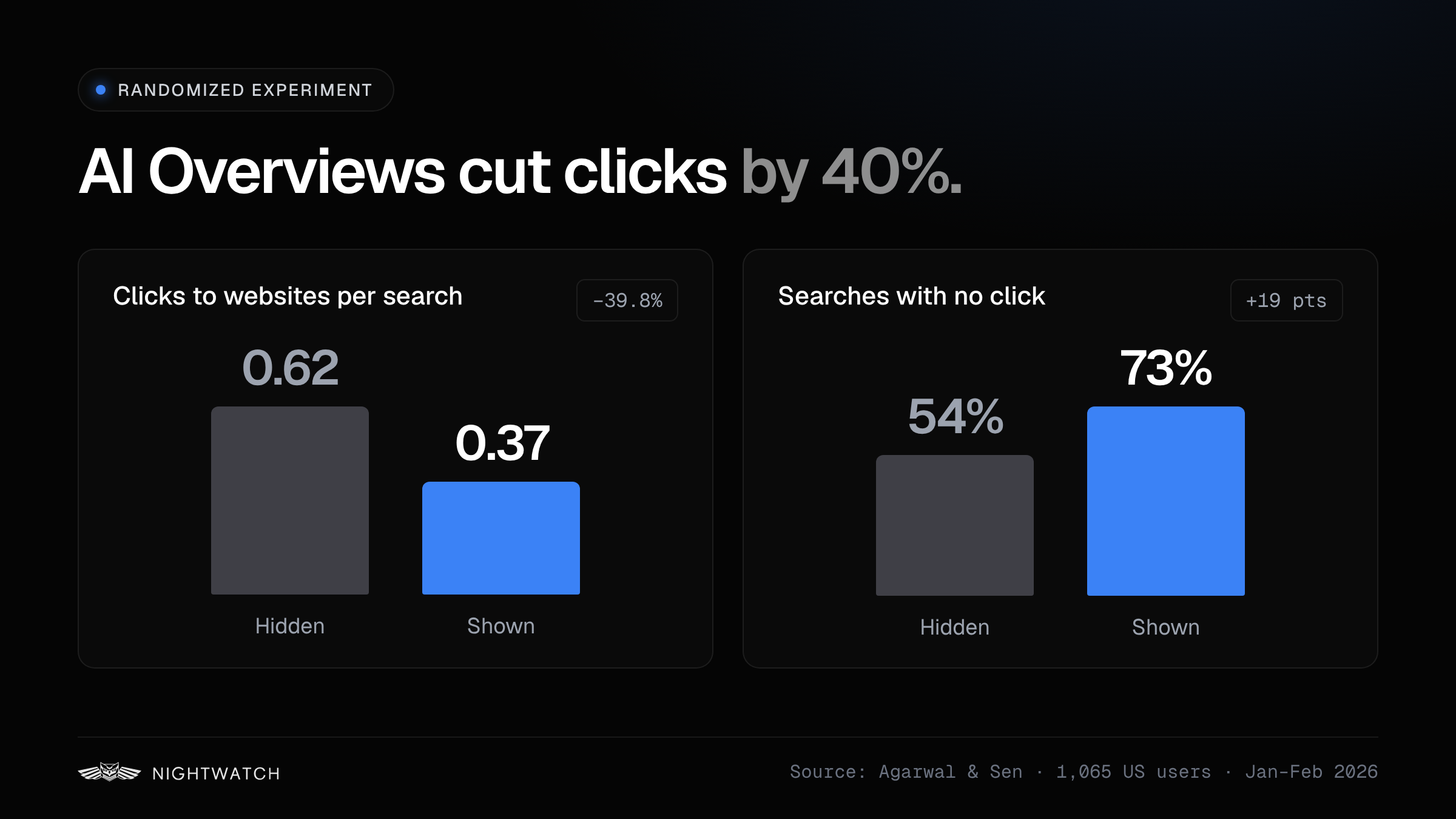
Saharsh Agarwal (Indian School of Business) and Ananya Sen (Carnegie Mellon) ran the first randomized field experiment on AI Overviews. They recruited 1,065 US desktop Chrome users and, for some of them, hid AI Overviews on queries where Google would have shown one. Over two weeks in January and February 2026 they observed 68,089 searches (summary by PPC Land).
The results:
- Outbound organic clicks per search fell from 0.62 to 0.37 when an AI Overview was shown. That’s a 39.8% drop.
- Zero-click searches rose from 54% to 73%.
- Ad clicks didn’t change. The Overview takes clicks from organic results, not from Google’s ads.
Two caveats: it’s a working paper (not yet peer reviewed) and it covers desktop only.
A second experiment agrees
In August 2026, a separate research team (Wang, Gleason, Bart, Wilson and Metaxa) published a second preregistered experiment with 1,100 participants. They found that removing AI Overviews and AI Mode increases click-through to publishers, and that an AI Mode-only experience reduced clicks further while also eroding users’ trust in the information.
Two independent randomized studies pointing the same way is about as strong as evidence gets in this field.
Observational data fills in the picture
Pew’s 2025 study (observational, so not causal on its own) is consistent with both experiments:
- Users clicked an ordinary result on 8% of visits with an AI summary, versus 15% without one.
- Only 1% of visits included a click on a link inside the summary.
- Users ended their browsing session on 26% of pages with a summary, versus 16% without.
INFO
Google’s position is that total organic clicks are “relatively stable year-over-year” and that clicks from AI-enhanced results are higher quality (Google, August 2025). Google didn’t publish numbers to support this, so we weigh it below the experiments.
What this means for you: a stable position no longer means stable traffic. When traffic drops while rankings hold, check whether an Overview started appearing for that keyword before you blame the content. That’s also why link equity in a no-click search world matters more than raw visits.
What 2,885 AI answers show about citations
Most GEO advice treats “AI search” as one thing. Our data says it isn’t.
Nightwatch asks AI engines the same questions every day and records every source they cite. For this article we pulled everything it collected for nightwatch.io between October 26 and November 25, 2026: 2,885 answers to 64 tracked prompts (33 distinct questions, such as “what is the best seo tracking tool?” and “how to monitor my visibility in ai?”) across ChatGPT, Perplexity, Google AI Overviews and Google AI Mode. Together they cited 27,346 links from 557 domains.
The questions are about SEO and AI-visibility software, mostly asked from the US in English, so the exact numbers belong to that niche. The patterns below are the ones big enough that we’d expect them to hold elsewhere, and they’re easy to check in your own category.
1. The engines barely agree on sources
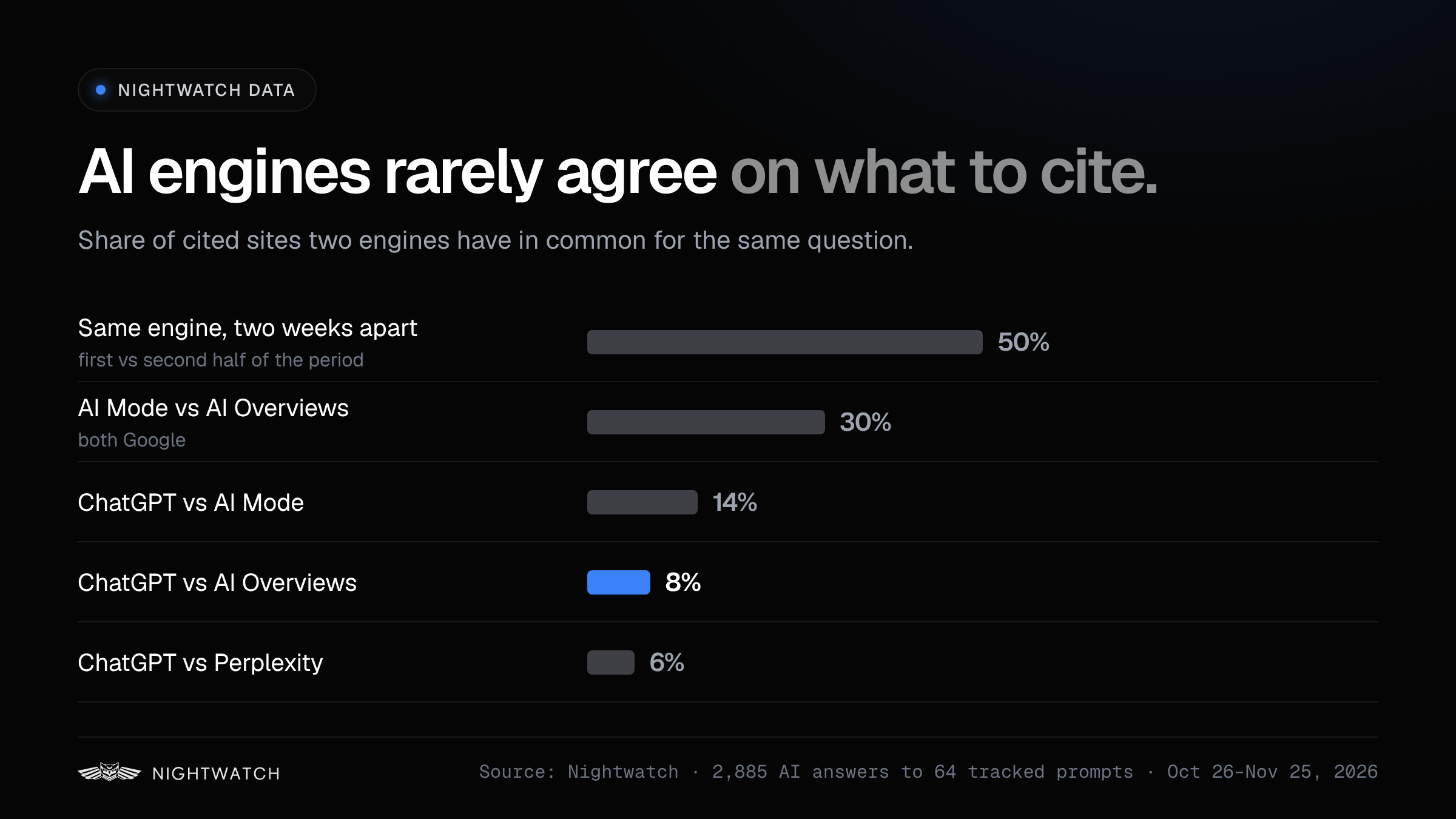
For each question asked on more than one engine, we compared the sites each engine cited over the month. ChatGPT and Google AI Overviews had only 8% of their cited sites in common. ChatGPT and Perplexity shared 6%. Even Google’s own two surfaces, AI Mode and AI Overviews, shared only 30%. Across engines from different companies, the average overlap was 9%.
For comparison, the same engine answering the same question two weeks apart kept about 50% of its sources.
So winning citations in ChatGPT tells you very little about Google, and the reverse. Each engine is its own channel, with its own sources to earn.
2. Google’s AI answers run on YouTube
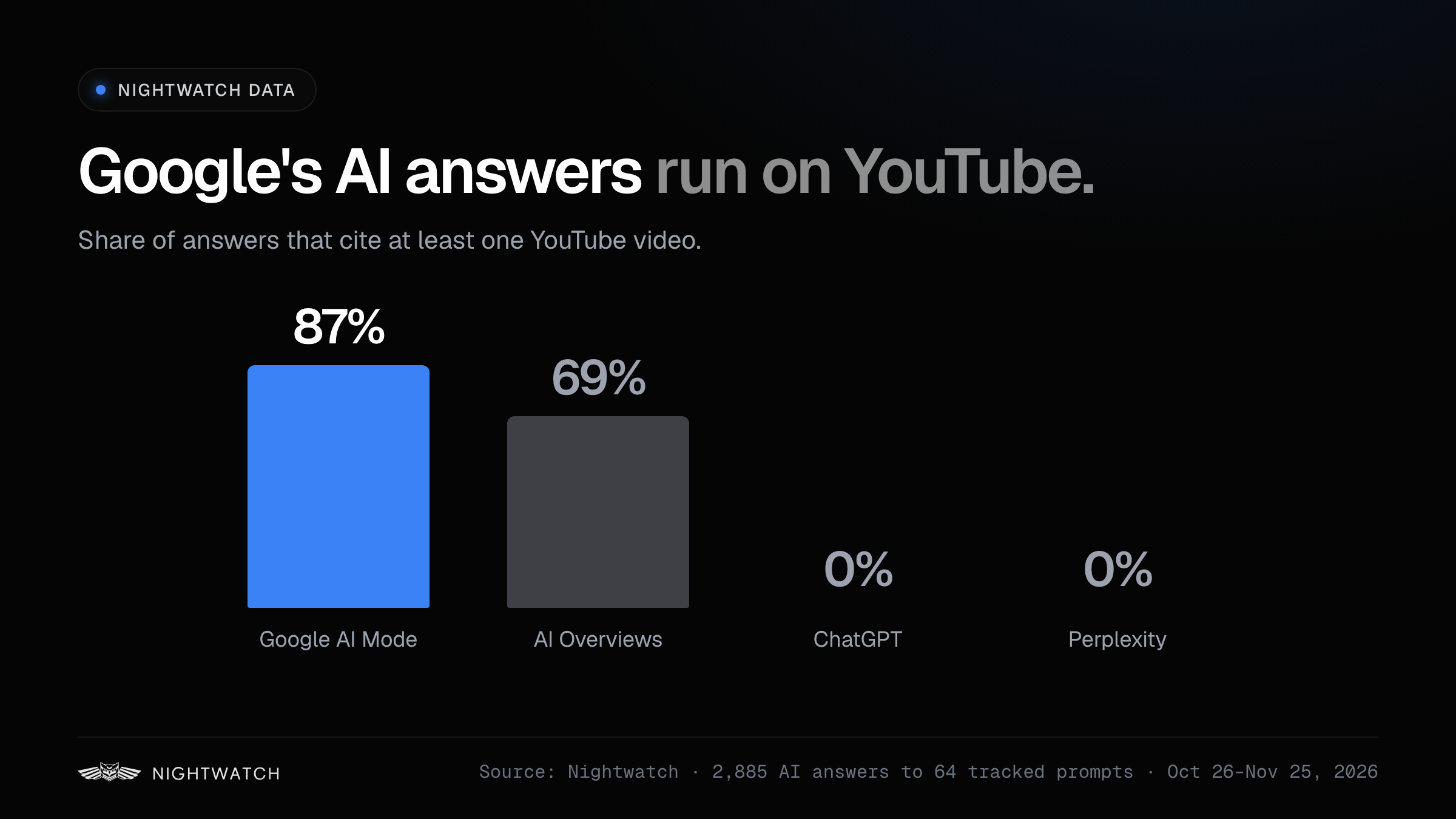
YouTube was the single most cited domain in our data, and it came entirely from Google. 87% of AI Mode answers and 69% of AI Overviews cited at least one YouTube video, and YouTube made up about 20% of all their citations. ChatGPT and Perplexity didn’t cite YouTube once.
Reddit showed the same split: it appeared in 47% of AI Mode answers and 17% of AI Overviews, and in none of the ChatGPT or Perplexity answers. Wikipedia, often named as a top AI source, barely registered for these software questions (0.01% of citations).
If Google’s AI matters for your category, a product walkthrough or comparison video can earn citations that no blog post will.
3. ChatGPT reads the toolmakers’ own sites
ChatGPT’s sources looked completely different. 19 of the 20 domains it cited most were the websites of companies selling SEO, AI-tracking or LLM-monitoring tools: their product pages, feature pages and blog posts. The 20th was Google Search Console. Those 20 domains made up 78% of everything ChatGPT cited.
Google’s AI drew more on third parties: videos, “best tools” roundups on software and media sites, and Reddit threads. For a software company, that splits the work in two. To show up in ChatGPT, your own site has to explain clearly what you do and who you’re for. To show up in Google’s AI, other people have to be talking about you.
4. A third of the sources change between checks
AI answers aren’t stable. Between two consecutive checks of the same question on the same engine, an answer kept on average 68% of the previous answer’s cited sites. ChatGPT was the steadiest (75% kept), Google AI Overviews and AI Mode kept 69% and 67%, and Perplexity kept only 33%, on a smaller sample. Only about one check in four came back with exactly the same set of sources.
That has a practical consequence: one screenshot of an AI answer proves very little. Whether you “are cited” is a rate, measured across many checks, not a yes or no.
How we measured
- Sample: every answer Nightwatch recorded for the 64 prompts tracked on nightwatch.io from October 26 to November 25, 2026. Gemini is left out because its answers returned almost no links.
- Citations: the linked sources shown with each answer, grouped by domain. Links that Google shows on every answer (terms of service, privacy policy, legal and help pages) are excluded.
- Overlap: for each question asked on two engines, the domains both cited divided by all the domains either cited over the month, averaged across questions.
- Limits: one niche, mostly US English, one month, and prompts chosen by us. It’s evidence about patterns, not a census of AI search.
What this means for you: stop asking “are we visible in AI?” and start asking it per engine and over time. Track the same prompts in ChatGPT, Perplexity and Google’s AI side by side, and look at citation rates over weeks rather than single answers. That’s what Nightwatch’s AI tracking is built for.
Ranking for one keyword isn’t enough anymore
If you rank #1, surely the AI cites you? Not necessarily, and the reason is in how AI answers are built.
It used to be close. An analysis of AI Overview citations found that in July 2025 about 76% of cited pages also ranked in the top 10 for the query. By March 2026, across 863,000 keyword SERPs, that had fallen to about 38%.2
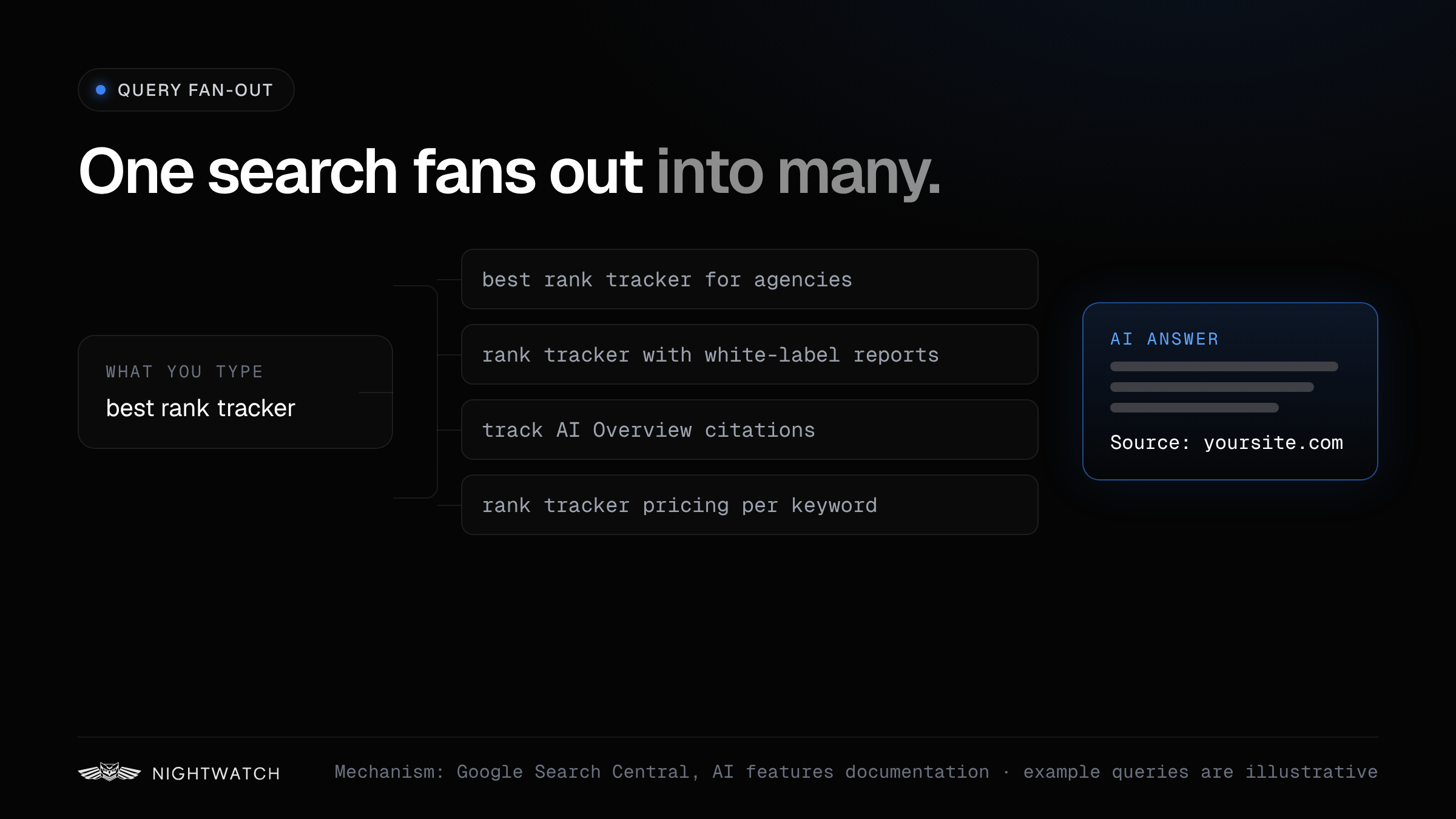
The mechanism is query fan-out. Google’s own documentation says AI Overviews and AI Mode “may use a ‘query fan-out’ technique — issuing multiple related searches across subtopics and data sources” (Google Search Central). The AI isn’t just reading the results for your keyword. It’s reading the results for five or ten related questions, then citing whatever ranks well across them.
That changes the strategy in a specific way:
- Ranking for the head term is necessary but not sufficient. You also need to rank for the sub-questions the AI asks behind the scenes.
- Thin “one keyword, one page” content loses. Pages that answer the main question and the obvious follow-ups get pulled in by more of the fan-out searches.
- Your competitors in AI answers may not be your SERP competitors. A page ranking #7 for a sub-question can beat your #1 for the head term.
What this means for you: for each money keyword, list the 5 to 10 follow-up questions a buyer would ask. Track those as keywords too. Nightwatch’s Citation Intelligence connects the two sides, showing which of your rankings are actually feeding AI citations.
What makes a page worth citing
So which pages get cited? There are two layers: which sites AI answers trust, and which pages are easy to quote.
Which sites: the places your category is discussed
AI answers lean heavily on reference and community sites. Pew found that Wikipedia, YouTube and Reddit alone made up 15% of the sources in AI summaries (Pew Research Center). Language models also learn which brands belong to a topic from how often they’re discussed alongside it. A 2025 study of 75,000 brands found that branded web mentions correlated with AI Overview visibility far more strongly (0.664) than the number of backlinks did (0.218).3 So being talked about in reviews, comparisons and community threads matters, not only being linked to. Our own data adds a twist: which of those places matters depends on the engine. Google’s AI leaned on YouTube and Reddit, while ChatGPT leaned on companies’ own sites (details above). That’s why brand citations in AI search deserve their own line in your reporting.
Which pages: what Google asks for
Google’s own guidance for AI features is short and unglamorous (Google Search Central). It asks you to:
- allow crawling in robots.txt and at your CDN or host,
- make content findable through internal links,
- provide a good page experience,
- put important content in text, not only in images or video,
- make sure your structured data matches the visible text on the page.
None of that is new. It’s SEO hygiene, and it’s the entry ticket for AI answers too.
Beyond the basics, the best page-level evidence comes from a 2026 study of 96,418 URLs that compared cited pages with uncited pages on the same sites.4 Pages cited more often had:
| Page feature | Citation rate vs uncited pages |
|---|---|
| Current year in the title (a sign of maintained content) | 2.7× |
| Table of contents with jump links | 1.7× |
| FAQPage structured data with genuine questions | 1.5× |
| Visible last-updated date | 1.3× |
| Ten or more external links | 1.3× |
These are correlations, not proof, but they point the same way as the lab evidence below.
Lab evidence: write to be quoted
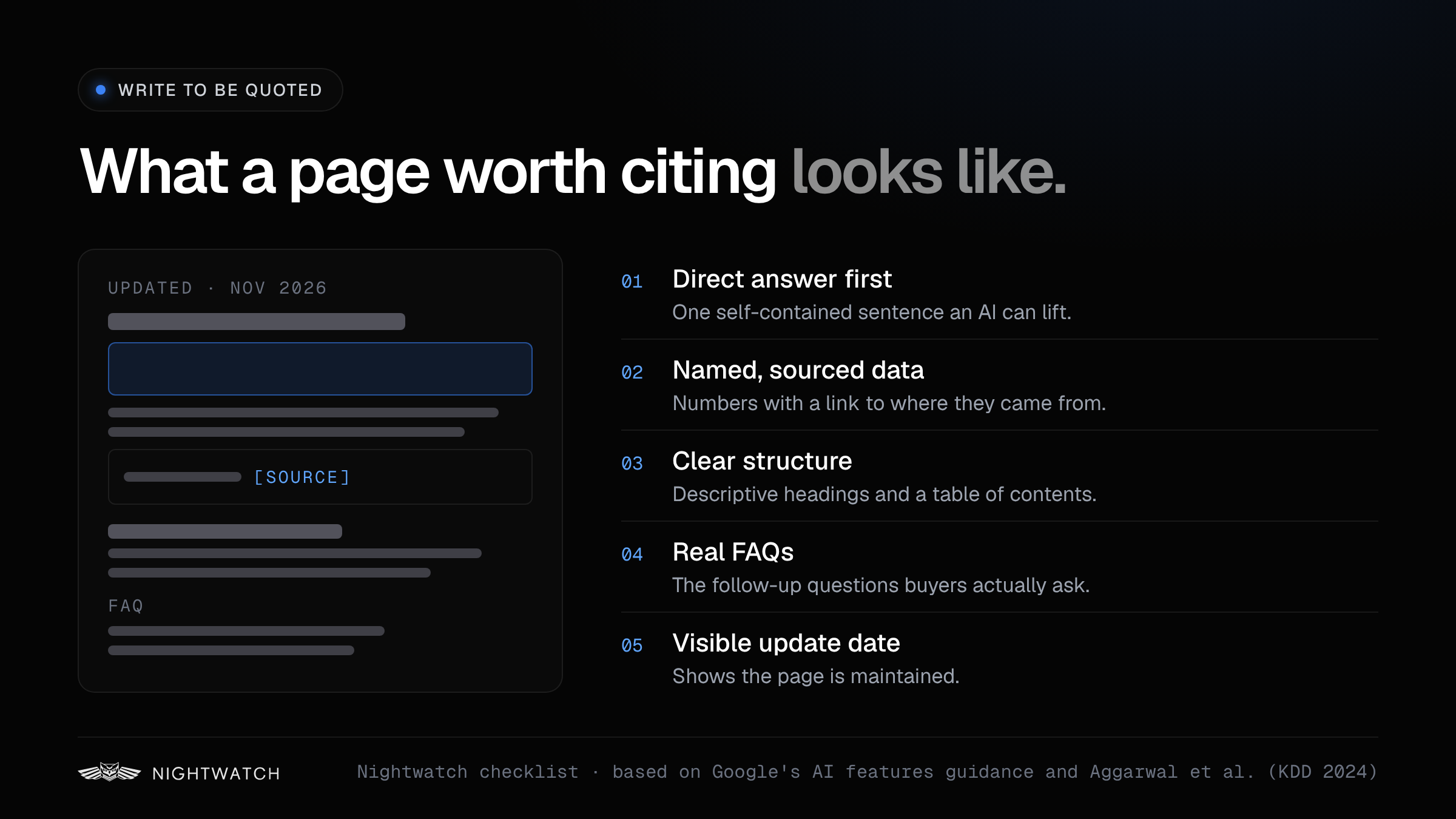
The original GEO paper (Aggarwal et al., KDD 2024) tested rewriting pages and measured how often a generative engine used them. Adding quotations, statistics and cited sources lifted visibility by up to 40%. It’s a lab test on older models, so treat the size of the effect as a hint, not a forecast. The principle behind it is sound, though: an AI answer has to lift a sentence from somewhere, and it prefers sentences that are self-contained, specific and backed by a source.
In practice that means the page anatomy above. Lead each section with a direct answer, back claims with named data, use clear headings and a table of contents, add genuine FAQs, and show when the page was last updated.
For a complete content workflow built on these findings, see our GEO content strategy guide.
What doesn’t work: llms.txt, AI schema and other shortcuts
Every new channel attracts shortcuts. These three have been tested and come up empty:
- llms.txt files. An analysis of about 300,000 domains found no correlation between having an llms.txt file and earning AI citations,5 and the 96,418-URL study above found no measurable effect either.4 Google is explicit that no AI text files are needed (see below).
- AI-specific markup or files. Google says plainly: “You don’t need to create new machine readable files, AI text files, or markup to appear in these features,” and there’s “no special schema.org structured data that you need to add” (Google Search Central).
- Keyword stuffing for LLMs. In the original GEO experiments, keyword stuffing was one of the weakest tactics tested (Aggarwal et al.). Language models read meaning, not term counts.
The same Google page sums up the official position: “There are no additional requirements to appear in AI Overviews or AI Mode, nor other special optimizations necessary.” Good SEO is still the entry ticket.
AI referral traffic: small, but worth more per visit
If AI Overviews take clicks away, do ChatGPT and Perplexity give them back? Not in volume, but the clicks they do send are valuable.
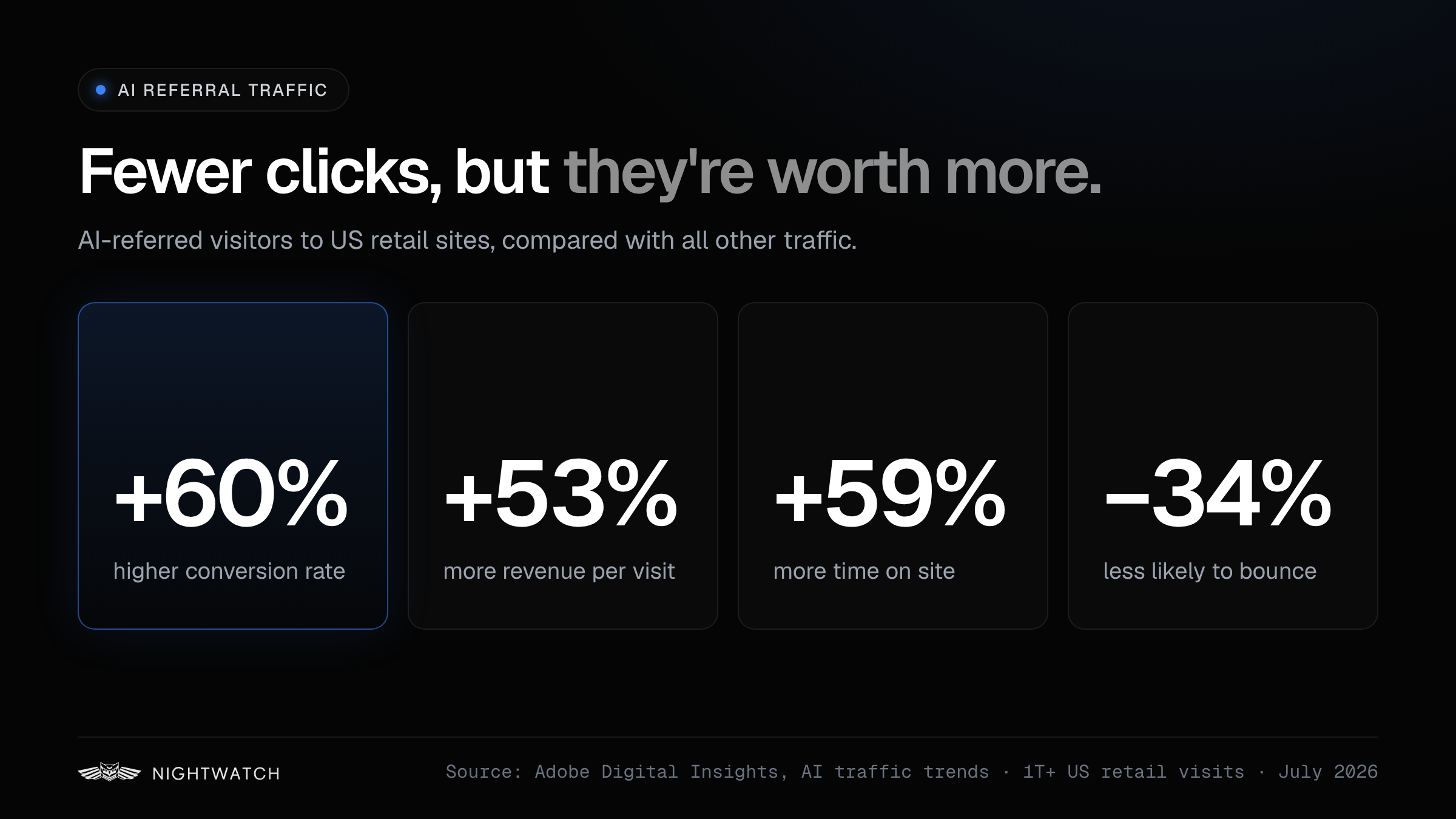
Adobe’s AI traffic trends report analyzes more than a trillion visits to US retail sites. In July 2026, compared with non-AI traffic, visitors referred by AI assistants:
- converted 60% more often,
- generated 53% more revenue per visit,
- spent 59% more time on site and were 34% less likely to bounce.
The AI share of retail visits also grew 62% year over year. It’s retail data from a single month, so check it against your own analytics before you forecast with it. Across all kinds of sites the channel is still small: a tracker covering 74,752 websites found AI assistants sent 0.28% of total traffic in March 2026.6 But the logic carries over to B2B: someone who has already asked an AI to compare options and then clicks through is further down the funnel.
What this means for you: don’t judge AI visibility by its traffic. Judge it by whether you’re named when buyers ask for recommendations, which is what AI share of voice measures.
The measurement gap
Here’s the practical problem. The tools most teams rely on can’t see step 2 of the funnel.
- Google Search Console counts AI Overview and AI Mode appearances inside the normal “Web” totals (Google Search Central). You can’t separate a click from an Overview citation from a click on a blue link.
- Analytics sees the click, if there is one. Most AI exposure produces no click at all, so analytics sees nothing.
- Classic rank trackers report your position, but not whether an Overview pushed it below the fold or whether you’re cited inside it.
- One-off AI checks mislead, because about a third of an answer’s sources change from one check to the next.
To manage the four-step funnel, you need one number per step:
| Funnel step | Metric | Where it comes from |
|---|---|---|
| Rank | Position for head terms and fan-out sub-questions | Rank tracker |
| Get cited | AI Overview citation rate, LLM mentions, share of voice | AI visibility tracker |
| Get clicked | CTR per keyword, AI referral sessions | Search Console, analytics |
| Convert | Signups and revenue by channel | Analytics, CRM |
Nightwatch tracks the first two in one place: classic rankings alongside AI visibility across ChatGPT, Perplexity, Gemini and Google AI features. Our guide on how to measure LLM visibility covers how to set the citation metrics up.
The evidence scorecard
Not every claim you’ll hear about AI search deserves the same weight. Here’s how the findings in this article stack up.
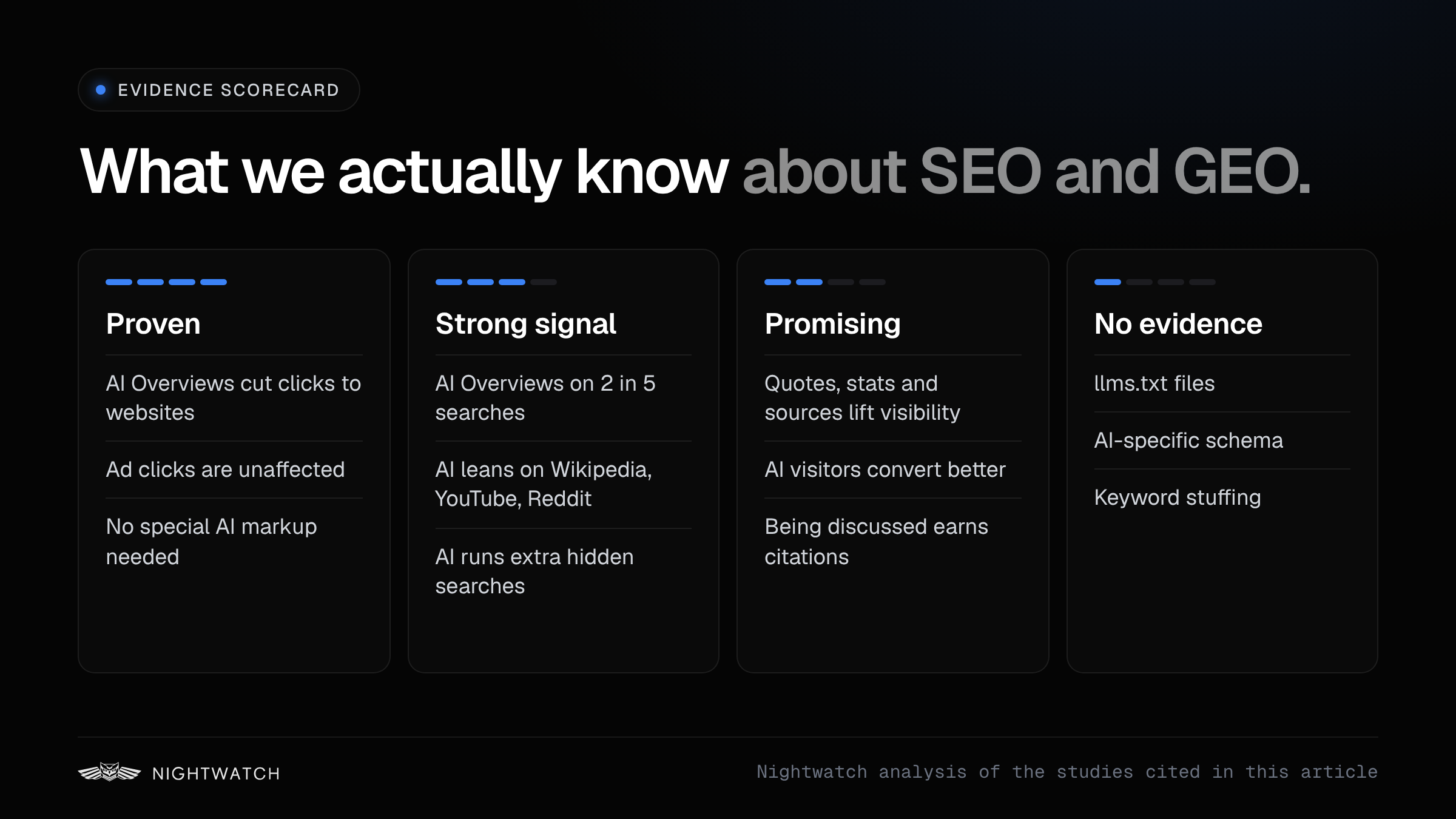
- Proven (randomized experiments or official statements): AI Overviews reduce outbound clicks. Ad clicks are unaffected. Google needs no special AI markup or files.
- Strong signal (large real-world samples or the platform’s own documentation): AI Overviews now appear on a large share of searches. AI answers lean on Wikipedia, YouTube and Reddit. Google’s AI runs fan-out searches on related sub-questions.
- Promising but unproven (lab tests or single-sector data): quotes, statistics and sources lift visibility. AI-referred visitors convert better. Being discussed in your category earns citations. From our own data: AI engines cite very different sources, Google’s AI leans heavily on YouTube, and answers change a lot between checks.
- No evidence: llms.txt, AI-specific schema and keyword stuffing for LLMs.
A useful rule: be willing to act on the middle two columns, because the cost of being wrong is low. But only forecast on the first.
The 2026 playbook: what to do, skip and measure
Do
- Keep the SEO foundations solid. Indexable pages, snippet eligibility, fast pages and a strong link profile are still the entry ticket for every AI answer that draws from search.
- Treat each AI engine as its own channel. Check which sources each one cites for your top questions. Our data shows they rarely overlap, so a win in one tells you little about the others.
- Map the fan-out. For each money keyword, list the follow-up questions a buyer asks and make sure you rank for them, either on the same page or on tightly linked pages.
- Earn mentions, not just links. Get your brand discussed where your category is discussed: reviews, comparisons, community threads, podcasts and YouTube. AI answers draw heavily on exactly those sources.
- Make video if Google’s AI matters to you. In our data, most Google AI answers cited a YouTube video. A clear walkthrough or comparison video is a citation opportunity that ChatGPT-focused tactics miss.
- Make your own site the best explanation of what you do. ChatGPT cited companies’ own product and blog pages heavily. Clear feature pages, honest comparison pages and specific use-case pages give it something to quote.
- Write to be quoted. Lead each section with a direct answer. Add original data, named sources and outbound links. Use a table of contents and real FAQs.
- Maintain, then show it. Update your important pages on a schedule, show the last-updated date and keep the year in the title current when the content actually is.
Skip
- llms.txt and other “AI files”. Google says they aren’t needed, and there’s no evidence they help.
- AI-specific schema. Google says it isn’t needed.
- Keyword stuffing for LLMs. It didn’t help in the original GEO tests.
- Panic rewrites of pages whose rankings are stable. Check first whether an AI Overview appeared.
Measure
- Per keyword: position, whether an AI Overview appears and whether you’re cited in it.
- Per prompt and per engine: whether ChatGPT, Perplexity, Gemini and Google’s AI mention or cite you, and alongside which competitors. Look at the rate over weeks, not a single answer.
- Per channel: AI referral sessions and their conversion rate, kept separate from organic.
- Per quarter: revenue from organic plus AI, not traffic alone.
TIP
If you’re starting from zero, pick your 20 most valuable keywords. Track their positions, AI Overview presence and citations for 30 days before changing anything. The baseline will tell you whether you have a ranking problem, a citation problem or a click problem, and each one has a different fix.
FAQ
Is SEO dead in 2026?
No. AI answers are built on top of search results, and Google says there are no extra requirements to appear in AI Overviews beyond normal SEO. What has changed is that ranking is now the first step rather than the last. You also need to be cited inside the answer and still earn the click.
What’s the difference between SEO and GEO?
SEO optimizes for ranking in search results. GEO (generative engine optimization) optimizes for being cited or mentioned in AI-generated answers from Google AI Overviews, AI Mode, ChatGPT, Perplexity and others. In practice, GEO is SEO plus two extras: brand presence on the sites AI answers draw from, and content that is easy to quote. Our GEO vs SEO comparison goes deeper.
How much traffic do AI Overviews take?
The best evidence is a randomized experiment that found a 39.8% drop in outbound organic clicks per search when an AI Overview was shown, with zero-click searches rising from 54% to 73%. Your own impact depends on how many of your keywords trigger an Overview and whether you’re cited in it.
Does ranking #1 get me cited in AI Overviews?
Not reliably. One analysis found only about 38% of AI Overview citations ranked in the top 10 for the same query in March 2026, down from about 76% in July 2025.2 Google says its AI answers use “query fan-out”, running extra searches on related sub-questions and citing what ranks across them. Ranking #1 for the head term helps, but ranking for the follow-up questions matters too.
Do ChatGPT and Google’s AI cite the same sources?
Rarely. In Nightwatch’s tracking of 2,885 answers about SEO and AI-visibility software, ChatGPT and Google AI Overviews had only 8% of their cited sites in common for the same question. Google’s AI cited YouTube in most answers, while ChatGPT never did and relied mostly on companies’ own websites. Plan and measure each engine separately.
Should I add an llms.txt file?
There’s no evidence it helps. Google says you don’t need AI text files or special markup to appear in its AI features, and no published study has shown llms.txt earning citations. It won’t hurt, but don’t expect results from it.
How do I track AI Overview citations and LLM mentions?
Search Console can’t separate them, because AI features are counted inside normal “Web” results. You need a tool that checks each keyword for an AI Overview and records which sources it cites, plus prompt tracking for ChatGPT, Perplexity and Gemini. Nightwatch does both alongside classic rank tracking.
Sources
- Agarwal and Sen, The Impact of Google AI Overviews on Publisher Traffic and User Experience: Evidence from a Field Experiment, SSRN working paper, 2026 (summary).
- Wang, Gleason, Bart, Wilson and Metaxa, AI in Search Reduces Publisher Referrals Without Improving User Experience, arXiv, August 2026.
- Pew Research Center, Google users are less likely to click on links when an AI summary appears in the results, July 2025.
- Google Search Central, AI features and your website.
- Google, AI in Search is driving more queries and higher quality clicks, August 2025.
- Aggarwal et al., GEO: Generative Engine Optimization, KDD 2024.
- Adobe Digital Insights, AI traffic trends report, August 2026.
Footnotes
-
Search Insider 2026, industry keyword panel, October 2026. ↩
-
Update: 38% of AI Overview citations pull from the top 10, March 2026. The July 2025 figure is from the same publisher’s earlier study, cited in this update. ↩ ↩2
-
An analysis of AI Overview brand visibility factors (75K brands studied), 2025, updated 2026. Spearman correlations. ↩
-
Citation worthiness: which GEO tactics hold up across 96,418 URLs, October 2026. ↩ ↩2
-
LLMs.txt: why brands rely on it and why it doesn’t work, October 2026. ↩
-
AI chatbot traffic: what it is, and how to get more, May 2026. ↩