
How to Use AI for Keyword Research: A 6-Step Practical Guide
Quick Takeaways
- AI keyword research uses machine learning and NLP to surface keyword opportunities, cluster by intent, and analyze SERP patterns far faster than manual methods.
- AI finds opportunities humans miss by detecting semantic relationships between terms and grouping keywords that share the same search intent — even when the wording looks completely different.
- Tools like Nightwatch’s AI SEO Agent combine real-time SERP data with keyword discovery, clustering, and competitor gap analysis in a single workflow.
- ChatGPT is useful for generating seed ideas and simulating FAQs, but its keyword metrics are unreliable — always validate with a dedicated rank tracking tool.
- Identifying content gaps from competitor keywords is one of the highest-ROI uses of AI in keyword research.
- The biggest mistake is treating AI suggestions as final. Human judgment is still essential to filter, prioritize, and validate what’s worth targeting.
Keyword research is the backbone of every successful SEO strategy — but it’s also one of the most time-consuming parts.
Before you can think about creating content that ranks, you might spend hours digging through endless keyword lists, analyzing competitors, filtering by intent, and grouping related terms into clusters. With a manual approach it’s easy to lose days just figuring out what your audience is actually searching for.
AI keyword research is changing that. Instead of wrestling with spreadsheets or juggling half a dozen tools, you can streamline the entire process using a single platform — and surface opportunities that manual research would miss entirely.
In this guide, you’ll learn exactly how to use AI for keyword research: what makes it different from traditional methods, how to run the process step-by-step using Nightwatch and ChatGPT, and how to validate AI suggestions with real rank data before you commit to a content plan.
Table of Contents
- What AI Keyword Research Is — and How It Differs from Traditional Methods
- How AI Finds Keyword Opportunities Humans Miss
- Step-by-Step: Using AI Tools for Keyword Research
- How to Use ChatGPT for Keyword Research and Strategy
- Using AI to Identify Content Gaps from Competitor Keywords
- Validating AI Keyword Suggestions with Real Rank Data
- Common Mistakes When Using AI for Keyword Research
- FAQ
What Is AI Keyword Research?
AI keyword research uses AI-powered tools to identify, analyze, and organize search keywords for SEO and content marketing. Unlike traditional methods that rely on manual research, AI keyword research leverages machine learning and natural language processing (NLP) to automate and enhance every step of the keyword discovery process.
In simpler terms, these tools can “think” through large sets of search data, understand context and user intent, and offer strategic keyword suggestions faster and more intelligently than any human or standard keyword tool could.
How Traditional Keyword Research Works
Before AI, keyword research typically meant:
- Typing seed keywords into Google Keyword Planner
- Downloading flat keyword lists
- Manually checking search volumes, competition levels, and CPC
- Trying to organize keywords into categories or content themes
- Looking up competitor data across separate platforms
- Making educated guesses about which keywords had the most potential
This process is slow, fragmented, and heavily dependent on the researcher’s intuition. You can easily miss entire clusters of relevant keywords simply because you didn’t think to type the right seed term.
How AI Changes the Equation
With AI, the same process is faster, smarter, and more thorough. For example, Nightwatch’s SEO AI Agent:
- Analyzes massive keyword databases in seconds
- Cross-references your site data with Google Search Console, Keyword Planner, and competitor data
- Categorizes keywords by user intent (informational, transactional, etc.)
- Clusters keywords into topic groups to help build SEO content plans
- Recommends optimizations based on live SERP data and ranking changes
- Continuously updates keyword priorities based on your website’s actual performance
The result is a research workflow that takes minutes instead of days — and surfaces insights that manual methods would never catch.
How AI Finds Keyword Opportunities Humans Miss
The most underappreciated advantage of AI in keyword research isn’t speed — it’s the ability to detect patterns and relationships in data that humans simply can’t process at scale.
Semantic Relationship Mapping
Traditional keyword tools work on exact-match or close-variant logic. You search for “project management software,” and you get variations of that phrase. You miss semantically related terms that don’t share the same words.
AI tools trained on large language models understand that “team task tracker,” “work assignment app,” and “project management software” can all represent the same search need. They map the conceptual space around a topic, not just the lexical variants — which means you discover keyword opportunities that competitors who rely on manual research will never find.
Intent Clustering
Two keywords can look identical in a keyword planner but attract completely different audiences. “Best CRM for small business” (commercial intent, comparing options) and “what is a CRM” (informational intent, early research) require different pages, different content structures, and different conversion goals.
AI identifies intent at scale by analyzing the actual SERP for each keyword — looking at the types of pages that rank, the content format, and the features Google surfaces (FAQs, product carousels, local packs). This is the basis of keyword clustering: grouping keywords not just by topic, but by the searcher’s goal. Matching intent correctly is one of the single highest-leverage levers in SEO.
SERP Pattern Analysis
AI tools don’t just look at keyword data in isolation — they analyze live SERP patterns to tell you what Google actually rewards for a given query. That means you get insights like:
- Which SERP features appear for a keyword (featured snippets, People Also Ask, video carousels)
- What content format is dominant (listicles, comparison pages, how-to guides)
- How competitive the top results are, and whether small sites can realistically break in
- Which competitor pages are over-optimized and vulnerable to displacement
This SERP-level intelligence is what separates AI keyword research from simply pulling a list of terms from a database. It’s the difference between knowing what people search for and understanding why they search for it and what content will satisfy them.
Long-Tail Discovery at Scale
Long-tail keywords — specific, lower-volume queries — are where most of the real opportunity lies, especially for newer sites. But manually identifying thousands of viable long-tail variants is impractical.
AI tools can generate, filter, and prioritize long-tail keywords at scale, cross-referencing them against competition data to surface high-opportunity terms that aren’t yet saturated. Paired with SEO segmentation, this approach lets you build a keyword strategy that works across multiple audience segments and content tiers simultaneously.
Step-by-Step: Using AI Tools for Keyword Research
For this walkthrough, we’ll use Nightwatch’s AI SEO Agent — which connects keyword discovery, clustering, competitor analysis, and rank tracking in a single platform. Here’s how to run the full process.
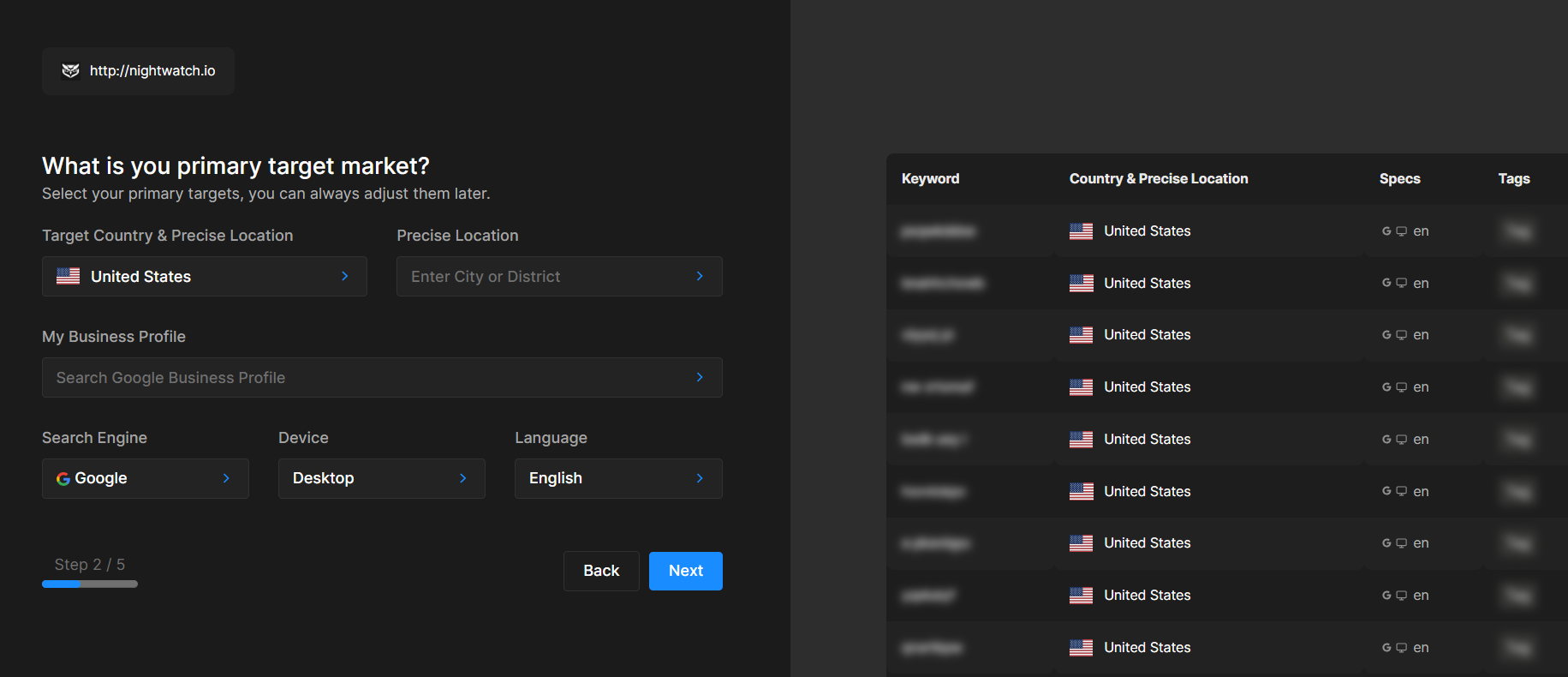
Step 1: Set Up Your Nightwatch Account and Project
Before you begin keyword research, you need to create an account and set up your project (your website or the domain you’re tracking).
-
Create a Nightwatch account: Sign up at nightwatch.io with your email.
-
Add your website: Enter your domain, company name, and preferred search engine settings (e.g., Google US or a local version).
-
Connect Google Analytics and Google Search Console (optional but strongly recommended): This lets Nightwatch pull real-time data from your existing search performance, so keyword suggestions are grounded in how your site actually performs.
Pro tip: If you manage multiple sites or clients, you can create and track different projects separately — which makes rank tracking across a portfolio much cleaner.
Step 2: Access the AI SEO Agent for Keyword Discovery
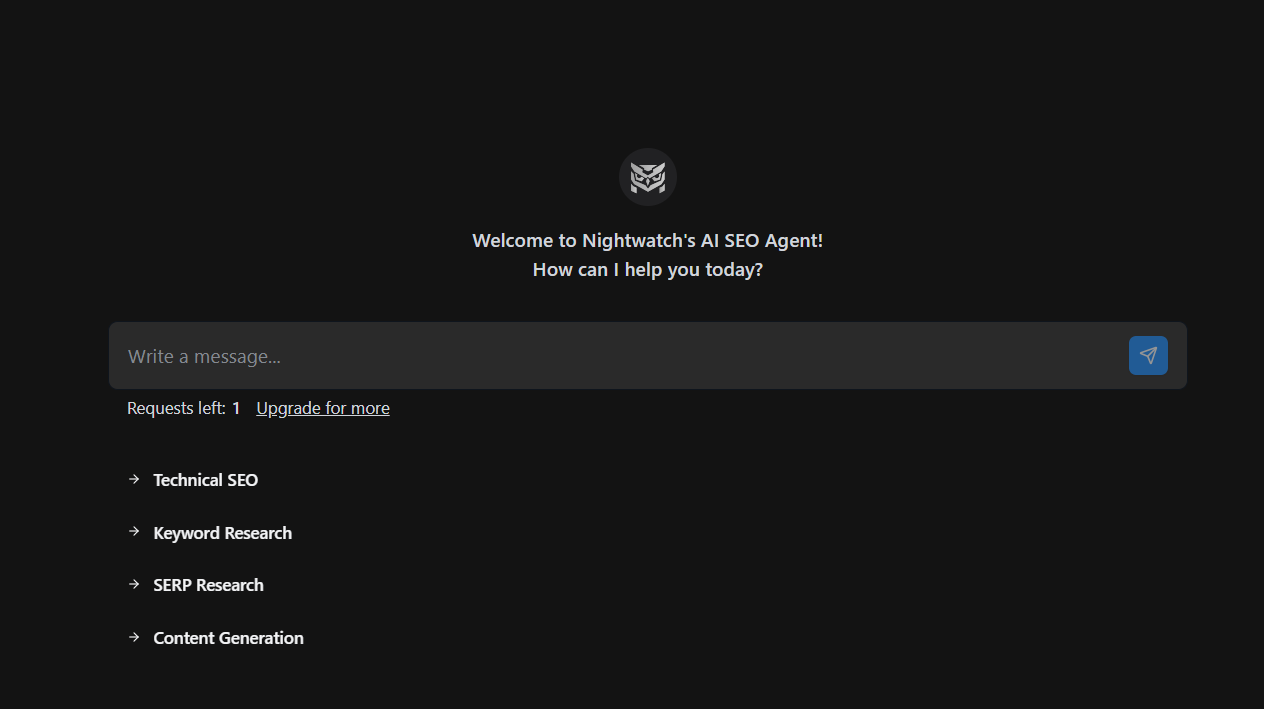
Once your project is set up, Nightwatch’s AI SEO Agent becomes your research assistant.
-
Go to agent.nightwatch.io
-
Select keyword research
-
Prompt the AI with your seed keyword or domain
Here’s a prompt you can use to get the most relevant results:
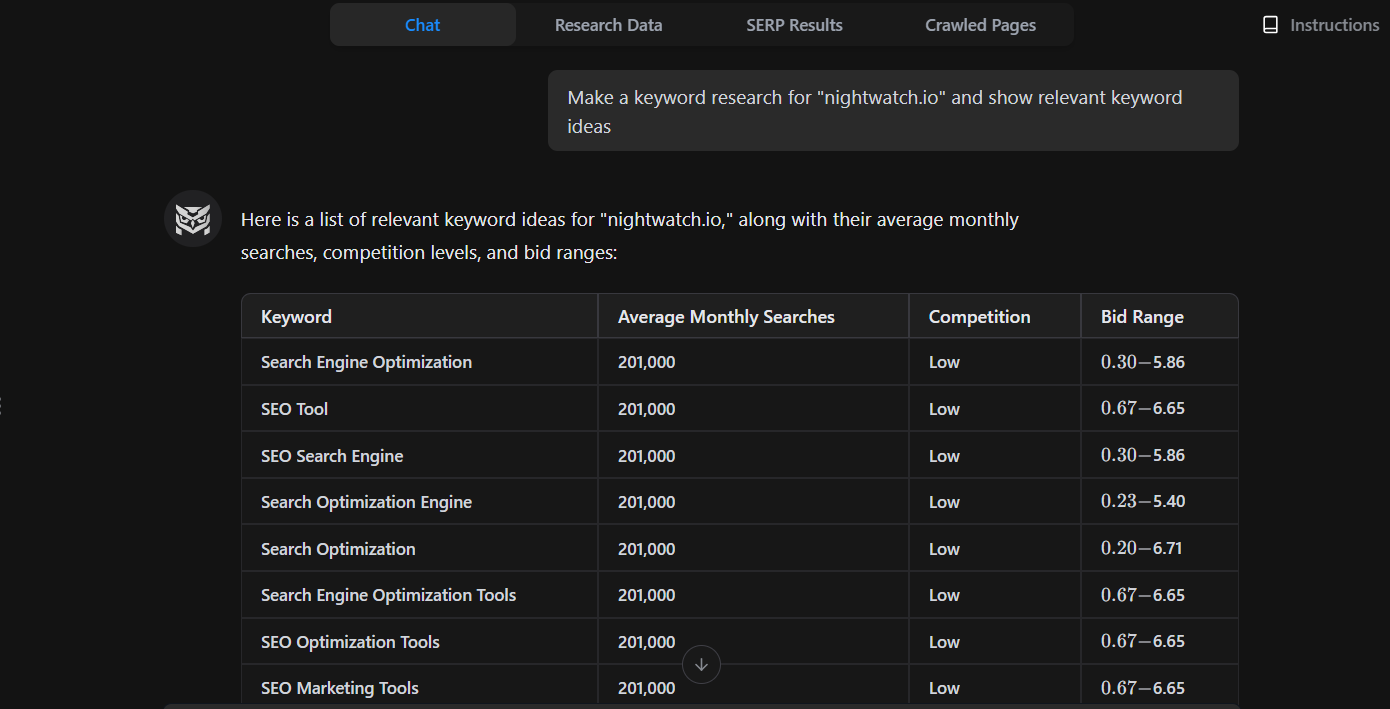
"Help me conduct in-depth keyword research for "[insert target keyword]." Include a list of high-volume, low-competition variations, long-tail keywords, and related questions people ask."Or, for domain-level discovery:
"Make a keyword research for {your domain}"The SEO Agent will analyze your site using multiple data sources — including Google SERPs and trends — and return relevant keyword suggestions within seconds.
Step 3: Analyze Keyword Metrics
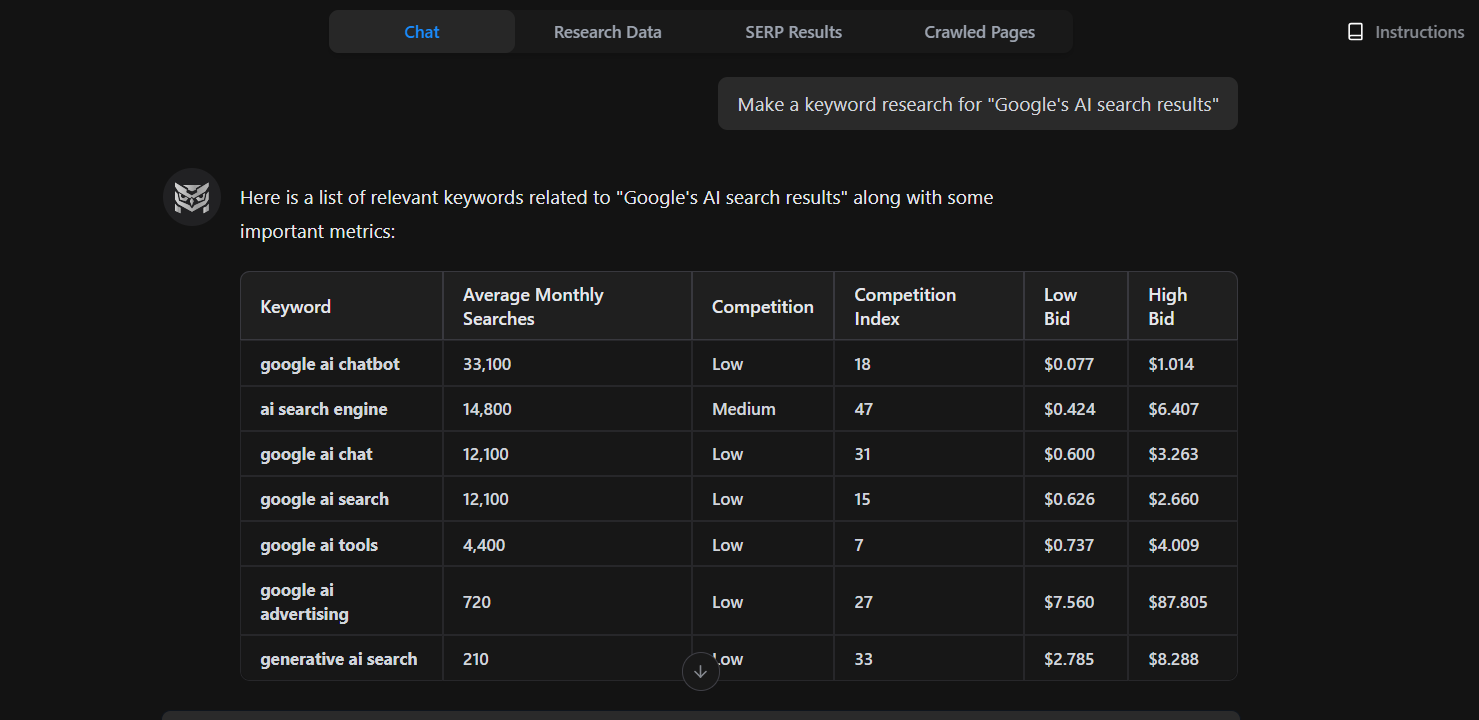
Each suggested keyword comes with essential metrics:
- Search volume: How many times is it searched per month?
- Competition: How hard is it to rank for that keyword?
- Competition index: How many advertisers are bidding on that keyword?
- Bid range: Useful if you’re also planning paid search campaigns.
- SERP data: Who is currently ranking for that keyword, and in what format?
Filter keywords based on your goals:
- Filter for low-difficulty, long-tail keywords if you’re running a newer site without much domain authority.
- Prioritize high-converting commercial or transactional keywords if you’re building landing pages.
These metrics remove the guesswork from prioritization.
Here’s an example of keyword research on “Google AI search results” — notice how the tool breaks down volume, difficulty, and SERP competition in one view:
Step 4: Use AI to Cluster Keywords by Topic and Intent
Nightwatch’s AI also clusters your keywords based on semantic similarity and user intent. This is critical for modern SEO — it helps you build topical authority, create focused content, and improve internal linking and on-page structure.
For example, from a broad seed topic like “remote hiring”:
- “Best remote hiring tools,” “top virtual hiring platforms,” and “AI tools for remote recruitment” → grouped into one theme
- “How to conduct remote interviews” and “steps to screen remote candidates” → grouped into another
You can trigger clustering as a separate task with this prompt:
"I have a list of keywords related to [your niche or topic]. Please group these keywords into logical clusters based on search intent and semantic similarity. Each cluster should have a clear theme or subject and a short label or heading."Or combine it with your initial research prompt:
"Help me conduct in-depth keyword research for '[insert target keyword].' Include high-volume, low-competition variations, long-tail keywords, and related questions. Group the keywords by search intent (informational, transactional, navigational) and suggest how they can be incorporated into the content strategy."Here’s what clustering looks like in the Nightwatch AI SEO Agent:
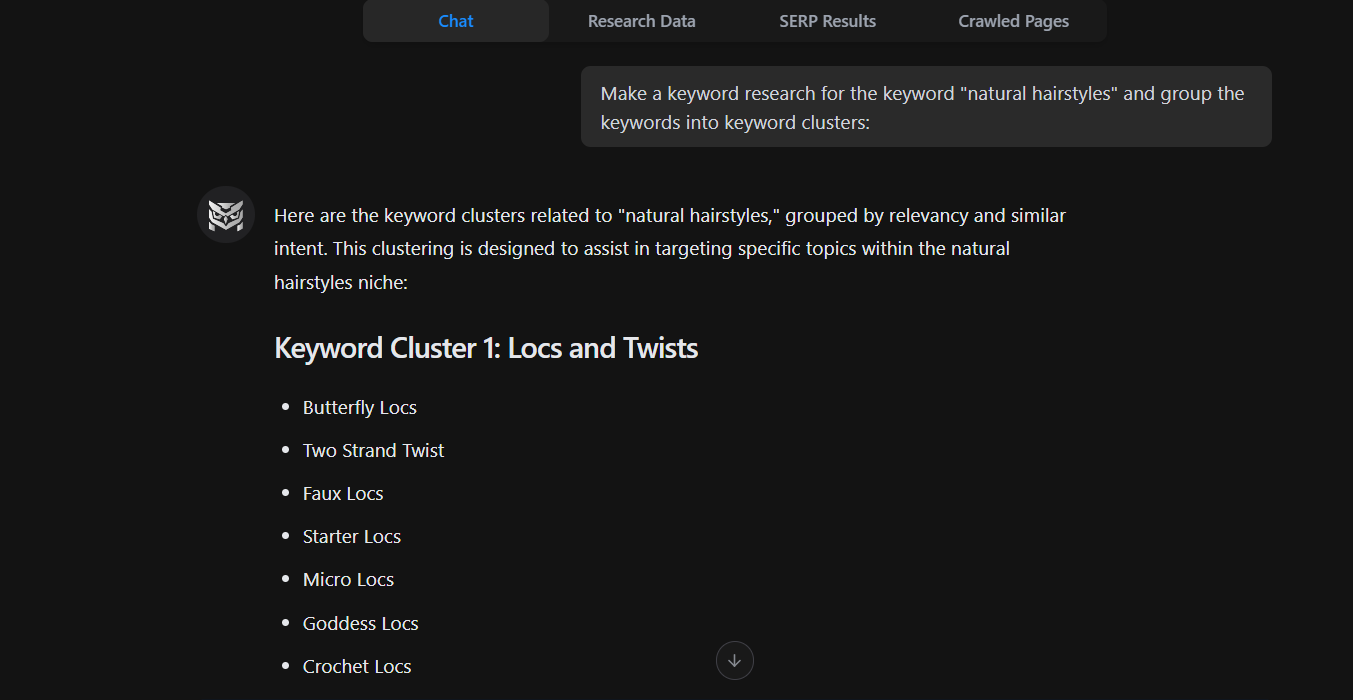
You can export these clusters directly as topic ideas or plug them into your content calendar.
Pro tip: Each cluster includes relevant SERP previews and competition data, so you can see exactly how Google interprets that topic — and what content format will perform best.
Step 5: Add Keywords to Rank Tracking
Once you’ve chosen your target keywords, add them to the Nightwatch dashboard to monitor their rankings over time. This closes the loop between research and results — you can spot slipping content, monitor new posts after publication, and make data-driven updates.
Nightwatch tracks:
- Desktop and mobile rankings separately
- Location-specific rankings (critical for local SEO)
- Ranking changes over days, weeks, or months
- Featured snippets, People Also Ask boxes, and other SERP features
You can also tag keywords into categories — “blog posts,” “product pages,” “cluster A” — to keep tracking organized across a large site.
Step 6: Discover Competitor Keywords and Content Gaps
The SEO AI Agent can analyze your top competitors and surface content gaps — keywords they rank for that you don’t — so you can systematically capture traffic you’re currently missing.
Use this prompt to run a gap analysis:
I want to analyze the keyword gap between my website and several competitors. Please identify keywords that:
- My domain does not rank for
- But two or more of the competitors do

Prioritize keywords with high search volume and low-to-medium competition. Also categorize the keywords by search intent (informational, commercial, transactional, navigational).

Here's the data:
My domain: [your domain]
Competitor 1: [competitor's domain]
Competitor 2: [competitor's domain]
With this prompt, you’ll get:
- A breakdown of competitors’ top-performing keywords
- Pages driving the most organic traffic
- Keyword overlap: What you both rank for
- Keyword gaps: What they rank for but you don’t
Feed those missing keywords back into the AI Agent to uncover new content opportunities. This approach lets you reverse-engineer competitors’ rankings and move faster.
How to Use ChatGPT for Keyword Research and Strategy
ChatGPT is a useful complement to dedicated SEO tools — particularly for generating seed ideas, simulating user questions, and building out clustering logic. It’s less useful for anything requiring real search volume or live SERP data.
Generate Keyword Ideas from Seed Topics
Feed ChatGPT a seed topic and ask it to generate keyword variations:
"Give me a list of 20 long-tail keywords related to 'AI in recruitment' with high commercial intent."You’ll get phrases like:
- AI tools for hiring developers
- Best AI recruitment software
- How to automate candidate screening
- AI-powered applicant tracking systems
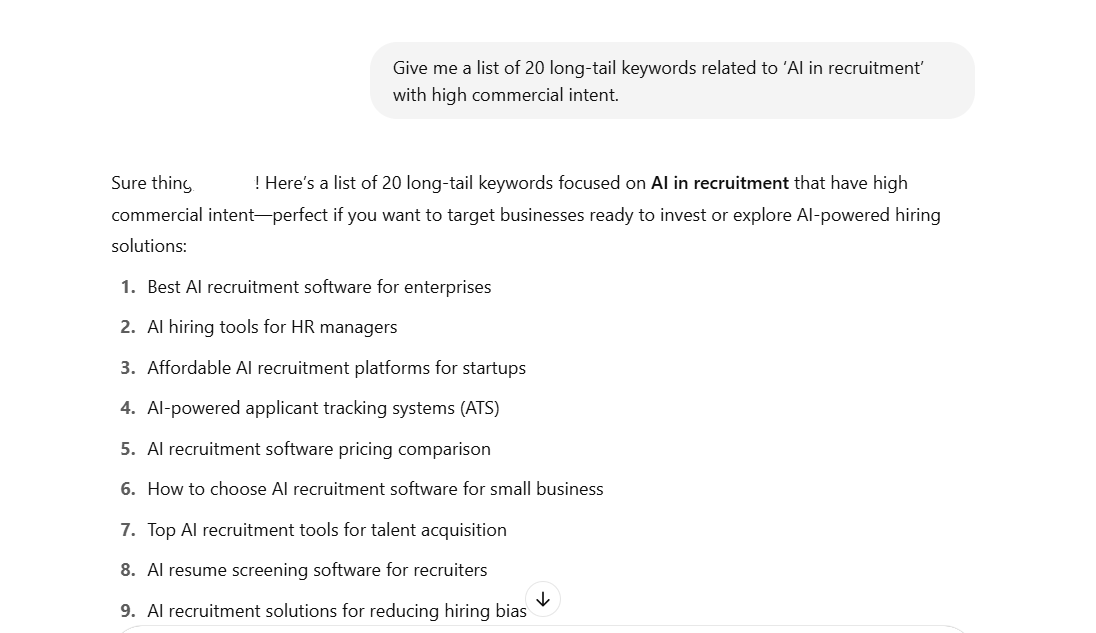
This works well when you’re starting from scratch, exploring a new niche, or need to quickly expand a seed list. The critical caveat: ChatGPT’s keyword volume and difficulty data is unreliable. Treat its output as a brainstorming layer, then validate every term with a dedicated AI SEO tool like Nightwatch.
Cluster Keywords by Topic or Intent
Once you have a raw list — from ChatGPT, Nightwatch, or any other source — you can paste it into ChatGPT and ask for clustering:
"Cluster these keywords into topic groups and label each group by user intent: [paste keywords here]."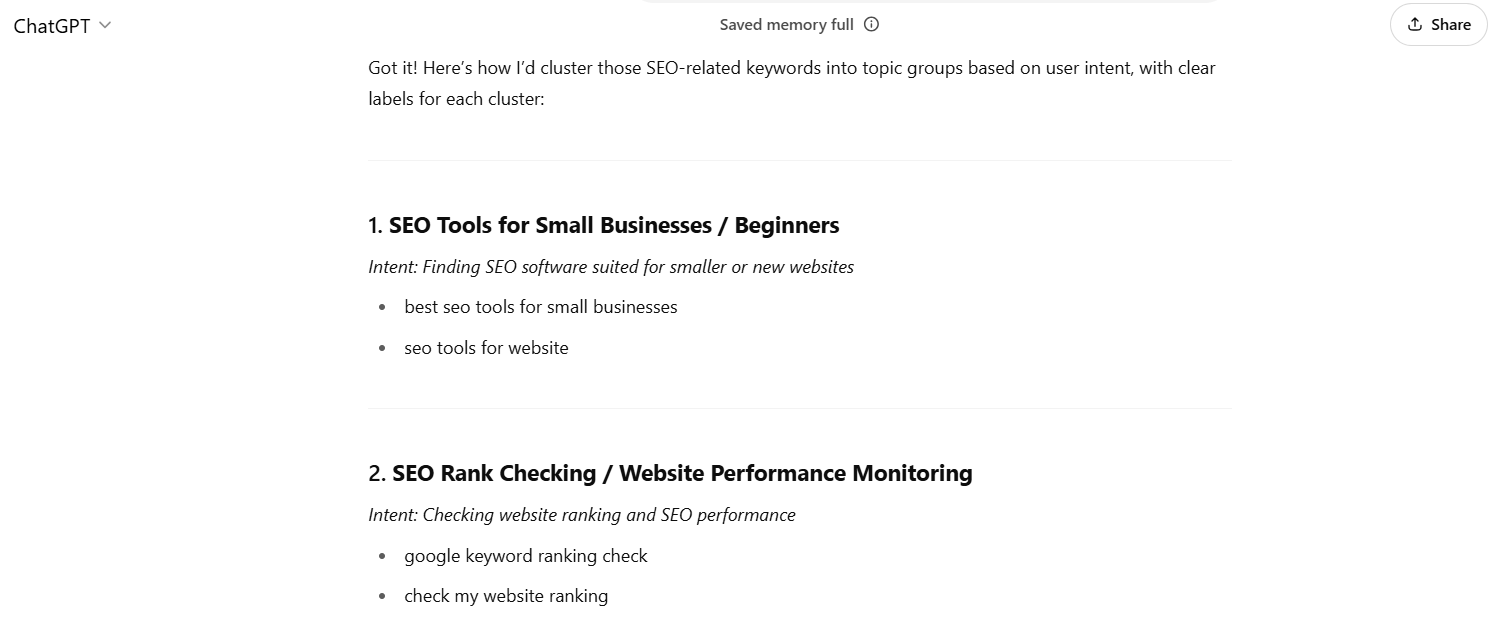
This gives you clear content angles based on keyword themes and search intent, which makes building a content calendar significantly faster.
Simulate FAQs and People Also Ask Questions
To optimize your content for Featured Snippets or the People Also Ask section, ask ChatGPT to generate relevant questions:
"What are the most common questions people have about using AI in hiring?"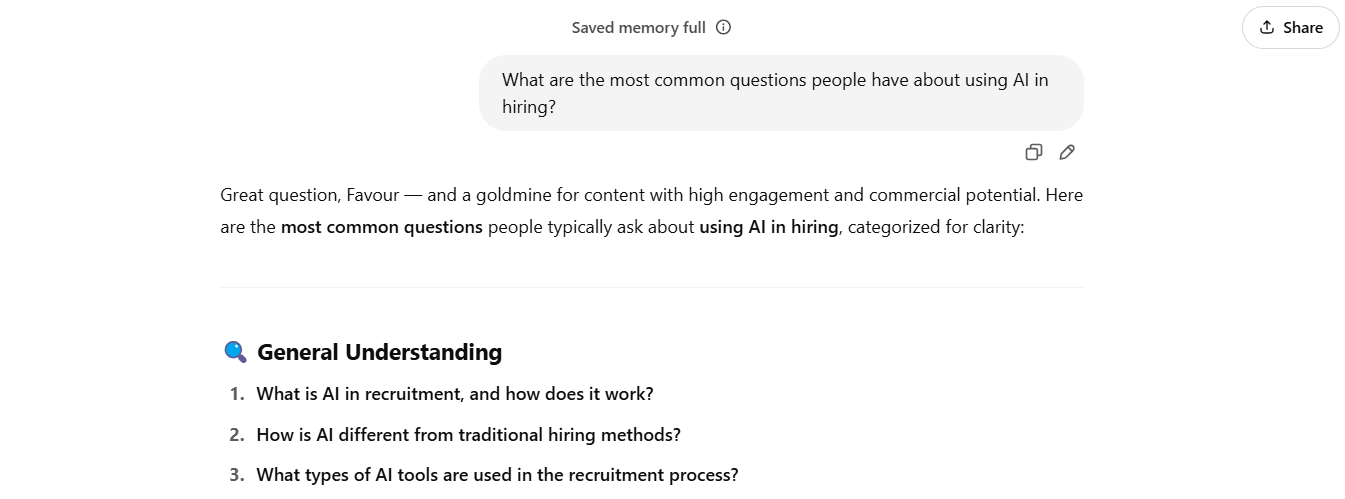
These questions make excellent subheadings and FAQ sections — and are often the exact phrasing Google surfaces in PAA boxes. Answering them directly in your content improves your chances of winning those features and boosting CTR.
Using AI to Identify Content Gaps from Competitor Keywords
Content gap analysis is one of the highest-ROI applications of AI in keyword research. The idea is simple: find topics your competitors rank for that you don’t, then create better content to capture that traffic.
Done manually, this requires exporting keyword lists from multiple tools, de-duplicating, cross-referencing, and filtering — a process that can take days. AI compresses it into minutes.
Here’s the workflow:
1. Identify your top 3–5 organic competitors — not necessarily your business competitors, but the sites competing with you on Google for the same keywords. You can prompt the AI: “Who are the top organic competitors for [your domain] in [your niche]?”
2. Run the gap analysis using the prompt from Step 6 above. The AI will surface keywords where multiple competitors have established rankings and you have none.
3. Prioritize gap keywords by opportunity — focus on terms with meaningful search volume, manageable competition, and clear fit with your existing content structure. Avoid chasing keywords that are too competitive for your current domain authority.
4. Map gaps to your content calendar — each gap keyword (or cluster of related gap keywords) becomes a content brief. Use Nightwatch’s AI Agent to build out that brief with supporting keywords, intent classification, and SERP format guidance.
5. Track the new content from day one — add each new piece to your rank tracker immediately after publishing so you capture ranking movement from the start. This is especially important for understanding how quickly Google indexes and responds to new content in your niche.
For a deeper look at this process, see the full guide on content gap analysis.
Validating AI Keyword Suggestions with Real Rank Data
AI suggestions are a starting point, not a final answer. Before committing content resources to any keyword, validate it against real data.
Check Actual Search Volume and Trend Direction
AI tools can surface a keyword that looks appealing on paper but is actually declining in search interest. Use Nightwatch’s rank tracker alongside Google Trends to confirm that volume is stable or growing — not in freefall.
Verify the SERP is Winnable
High search volume means nothing if the top 10 results are all established industry authorities with thousands of backlinks. For each priority keyword, manually check:
- Who ranks in positions 1–5?
- What is their domain authority?
- What content format dominates (guides, tools, product pages)?
- Are there any weaker pages in the top 10 that indicate Google hasn’t found a fully satisfying answer yet?
If the top results are all high-authority domains with comprehensive content and strong link profiles, that keyword may not be worth pursuing until your own authority grows.
Confirm Intent Match
Rank for the wrong intent and you’ll get traffic that doesn’t convert. Before finalizing a target keyword, pull up its SERP and audit the top results. If Google is surfacing e-commerce product pages and your plan is to write an informational blog post, misalignment will hurt your rankings regardless of how good the content is.
AI tools are generally good at intent classification, but they’re not perfect — especially for ambiguous queries. A manual SERP check takes 60 seconds and can save weeks of wasted content effort.
Use Rank Tracking to Close the Loop
Once you publish content targeting a keyword, add it to Nightwatch and track its ranking trajectory from day one. This is the feedback loop that makes AI keyword research genuinely useful over time: you discover keywords with AI, publish content, track rankings, and feed that performance data back into your next research cycle.
If a keyword isn’t moving after 3–4 months, you have two options: improve the content (deepen coverage, add supporting sections, improve on-page optimization) or reassess whether the keyword was worth targeting in the first place.
This is also where AI SEO tools differentiate from simple keyword databases — they learn from your site’s actual performance and surface increasingly relevant suggestions over time.
For sites that need to track AI-generated search visibility specifically, LLM tracking tools are an emerging layer on top of traditional rank tracking — useful if you’re starting to appear (or want to appear) in answers from ChatGPT, Perplexity, and similar AI-powered search interfaces.
Common Mistakes When Using AI for Keyword Research
AI tools are powerful, but they introduce new failure modes alongside the efficiencies. Here are the most common mistakes to avoid.
Treating AI Suggestions as Final
AI generates hypotheses, not answers. Every keyword suggestion needs to be validated against real search volume data, SERP analysis, and your site’s competitive position. Teams that skip this step burn content resources on terms that don’t convert or can’t be won.
Ignoring Search Intent
AI can misclassify intent — particularly for ambiguous queries. Always verify the dominant content format in the SERP before writing. A keyword like “best project management tool” looks commercial, but if the SERP is full of comparison listicles, publishing a product page will underperform regardless of how well it’s optimized.
Over-Clustering
AI is excellent at clustering, but it can generate too many clusters, some of which represent the same audience need. Over-clustering leads to content fragmentation — multiple thin pages competing against each other instead of one authoritative piece. Combine small clusters where the underlying search intent is the same.
Chasing Volume Over Relevance
High-volume keywords are tempting, but if they don’t align with your site’s topical authority or your audience’s actual needs, the traffic you generate won’t convert. Prioritize relevance and intent fit over raw volume — especially early on.
Not Feeding Results Back Into Tracking
Keyword research without rank tracking is incomplete. If you never measure whether the keywords you targeted are actually moving, you have no feedback loop. You’ll keep generating new content while older content silently slides in the rankings without anyone noticing. Connect your AI keyword research to rank tracking from the start.
Using ChatGPT Alone for Keyword Metrics
ChatGPT is valuable for brainstorming and clustering but shouldn’t be used as a source of keyword volume or competition data. Its training data has a cutoff, it has no live SERP access by default, and its volume estimates are often inaccurate. Use it for ideation; use Nightwatch for metrics.
FAQs
How can AI be used for keyword research?
AI can analyze large datasets, identify keyword patterns and related terms, detect search intent, and cluster keywords by topic — all far faster than manual methods. Tools like Nightwatch’s AI SEO Agent use machine learning to automate the discovery, clustering, and prioritization stages of keyword research, while tools like ChatGPT are useful for brainstorming seed ideas and simulating FAQ content.
What are the best AI tools for keyword research?
Nightwatch’s AI SEO Agent is one of the strongest options for full-cycle AI keyword research — it combines live SERP data, keyword discovery, intent clustering, competitor gap analysis, and rank tracking in one platform. ChatGPT is a useful complement for ideation and content planning, but should be paired with a dedicated SEO tool for data accuracy. Other tools worth evaluating include Semrush’s AI features, Ahrefs’ keyword explorer, and Surfer SEO.
Can AI keyword research replace manual SEO analysis?
AI dramatically speeds up research and surfaces patterns humans would miss, but human judgment remains essential. You still need to evaluate whether a keyword is strategically worth pursuing, assess the true competitive landscape, and validate that AI-suggested intent classifications match what the SERP actually shows. The best workflows combine AI-powered research with experienced SEO judgment.
How accurate is AI-generated keyword data?
Accuracy varies significantly by tool. Tools like Nightwatch pull real-time SERP and keyword data from authoritative sources (Google Search Console, Keyword Planner, live SERPs), which makes them reliably accurate. Standalone LLMs like ChatGPT have training cutoffs and no live search access, so their volume estimates and keyword suggestions should be treated as directional ideas that need validation, not hard data.
How do I validate AI keyword suggestions before publishing content?
Run every AI-suggested keyword through four checks: (1) confirm real search volume from a live data source, (2) verify the SERP is competitively winnable for your domain authority level, (3) check that the dominant SERP content format matches what you’re planning to create, and (4) add the keyword to rank tracking from the moment you publish so you can measure results and iterate.
Boost Your SEO Strategy with AI-Powered Keyword Research
AI is changing how SEOs approach keyword research — from a slow, manual, intuition-driven process to a fast, data-rich, systematic one. The opportunity isn’t just to work faster; it’s to find keyword opportunities that traditional methods would miss entirely.
By combining Nightwatch’s AI SEO Agent — which delivers real-time SERP and keyword data, intent clustering, and competitor gap analysis — with ChatGPT’s strength in brainstorming and ideation, you can build a keyword research workflow that’s both comprehensive and efficient.
The key is to treat AI as a collaborative layer in your SEO process, not a replacement for strategic thinking. Use it to discover and organize at scale. Use human judgment to prioritize, validate, and execute.
Ready to put AI keyword research into practice? Start with Nightwatch’s AI SEO Agent and let it do the heavy lifting — so your keyword research gets done faster, smarter, and with less guesswork.