5 Best Local Rank Tracking Tools for Marketers in 2026
Quick Takeaways
- Local rank tracking tools use GPS coordinate-based geo-grids to show exactly where your business appears in search results across different neighborhoods — standard rank trackers can’t do this.
- The Local Pack captures 44% of all clicks in local search results, making local-specific rank monitoring essential for any business targeting nearby customers.
- Nightwatch is the top pick for most businesses and agencies: it combines visual heatmap grids, GPS-precise tracking across organic results, Local Pack, and Google Maps, plus Google Business Profile monitoring and white-label reports — starting at $32/month.
- Key features to evaluate: geo-grid density and customization, update frequency (daily vs. weekly), Google Business Profile integration, multi-location support, competitor tracking, and reporting quality.
- There are meaningful differences between local and national rank tracking — local results shift based on the exact GPS coordinates of the searcher, so the same query can produce different results just a few blocks apart.
- All five tools reviewed offer free trials, so you can test before committing to a paid plan.
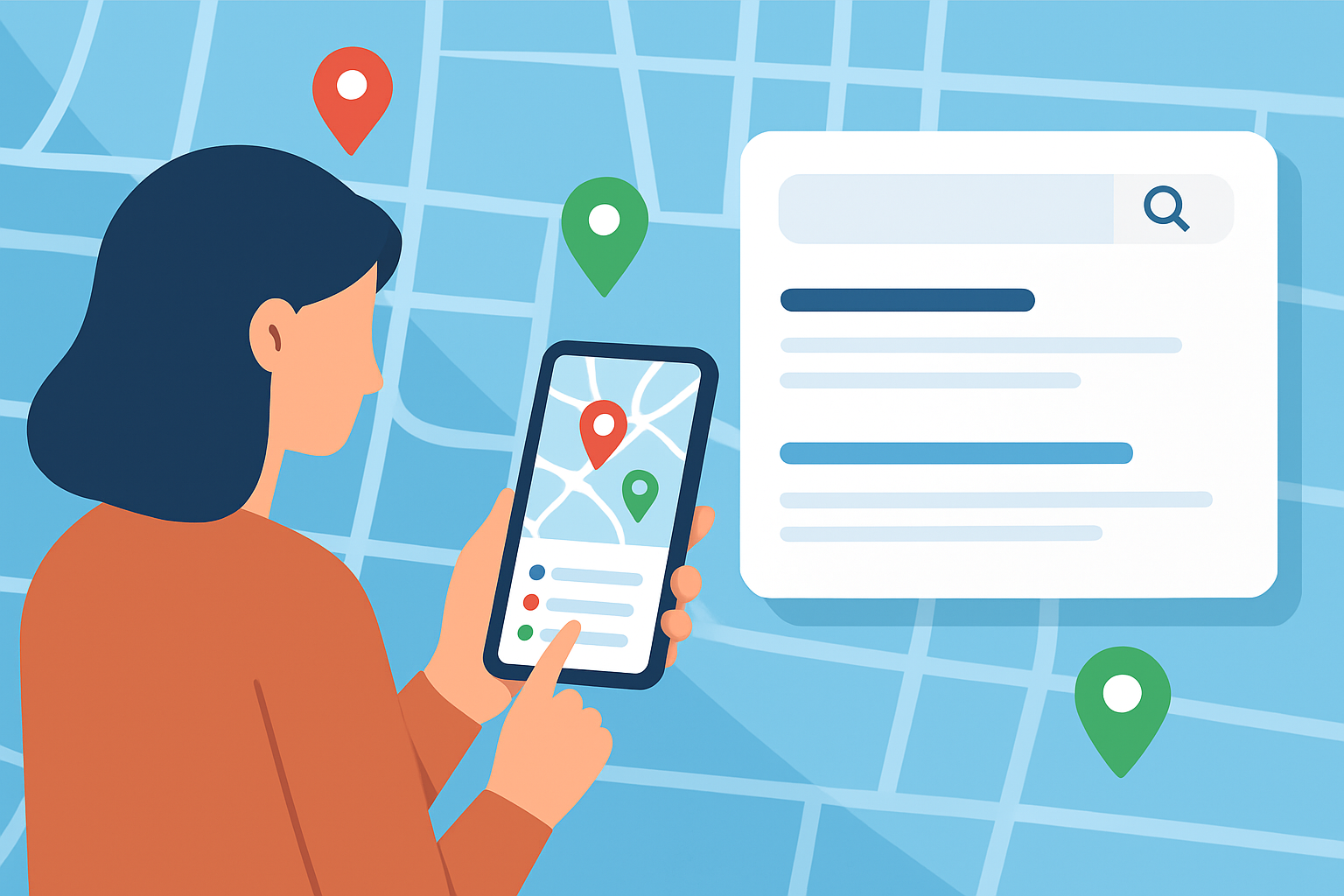
When someone pulls out their phone and searches “best pizza near me” or “emergency plumber,” where you appear on Google Maps literally decides whether they’re clicking your listing or moving on to the next one. And the numbers don’t lie: 46% of all Google Searches have local intent, and 76% of people who search for something nearby visit a business within 24 hours.
That’s opportunity slipping away if you’re not visible.
But tracking where you actually rank isn’t as simple as just looking up your store on Google. You need to know your position across different neighborhoods, understand how your Google Business Profile is doing, and keep tabs on the competition. Your basic rank tracker can’t handle all that.
So we did the legwork. We tested the market and found the best local rank tracking tools that actually work. These tools help you dominate local search, stay visible in the right places, and convert those searches into paying customers.
Table of Contents
- What Are Local Rank Tracking Tools?
- Local vs National Rank Tracking: Key Differences
- Why You Need a Local Rank Checker Tool
- What to Look for in Local Rank Tracking Software
- 5 Best Local Rank Tracking Tools for 2026
- Comparison Table
- Frequently Asked Questions
What Are Local Rank Tracking Tools?
Local rank tracking tools are specialized SEO software that monitor where your business shows up in location-specific search results. Unlike traditional rank trackers that show nationwide positions, local rank trackers reveal exactly where you appear when someone searches from specific GPS coordinates or service areas.
Here’s what they track:
- Your organic results in local search
- Local Pack rankings (that crucial map-based 3-pack at the top of Google Search Results)
- Where you stand on Google Maps
- Your Google Business Profile’s visibility across different locations
- Even Apple Maps rankings for iOS users
The key differentiator here is geo-grid technology. Instead of checking rankings from a single location, these tools track your visibility across a custom geo-grid that covers your entire service area. This location-specific data shows exactly where potential customers can find you, by highlighting the areas where you’re performing strongly and the spots where you’re virtually invisible. For developers building custom local SEO solutions, a SERP API provides granular location-based search data programmatically.
Local vs National Rank Tracking: Key Differences
Before diving into the tools, it’s worth understanding why local rank tracking is a fundamentally different discipline from national or global rank tracking — and why you can’t simply use a standard rank tracker for local SEO.
| Dimension | National Rank Tracking | Local Rank Tracking |
|---|---|---|
| What’s measured | A single, averaged ranking position | Rankings from dozens or hundreds of specific GPS coordinates |
| Result variability | Low — results are relatively consistent across the country | High — rankings shift block by block within the same city |
| Key SERP features | Featured snippets, People Also Ask, organic results | Local Pack (3-pack), Google Maps pins, GBP knowledge panels |
| Update impact | Large-scale content or link changes move the needle | GBP updates, citation consistency, and review signals drive local changes |
| Competitor set | National brands in the same category | Other businesses within your city or service radius |
| Reporting goal | Organic traffic and conversion by keyword | Visibility percentage across a service area map |
The most important practical difference: in local search, rankings are hyperlocal. A searcher standing outside your competitor’s door might see them at position one and you at position four. Someone standing outside your store might see the reverse. National rank trackers report one average position and completely miss this geographic variation.
This is why geo-grid tracking — where tools simulate searches from a grid of GPS coordinates across your service area — is essential for understanding real local visibility. Without it, you’re flying blind.
Tracking local rankings accurately also means monitoring three distinct search surfaces (organic, Local Pack, and Maps) separately, since your performance varies between them. You might rank on the first page organically but be absent from the Local Pack entirely, which is a significant missed opportunity given how prominently the map pack appears in local search results.
Why You Need a Local Rank Checker Tool
Local search isn’t one-size-fits-all. Your rankings shift depending on where a customer is searching from, so standard SEO tools and rank trackers can’t tell you the full story. A local rank checker is specifically built for this, as it shows exactly where you’re visible and where you’re missing out.
Monitor Hyperlocal Search Performance
Local rankings jump around based on GPS coordinates. A searcher three blocks away might see you at number one, while someone five blocks away doesn’t see you at all. A local rank checker gives you accurate position tracking across your entire service area, showing exactly where you’re visible and where you’re bleeding opportunities. This detailed insight into local keyword rankings tells you which neighborhoods need attention and which marketing activities are actually working.
Dominate the Local Pack
The Local Pack consists of three businesses, each with a map pin at the top of local search results, which capture the lion’s share of customer engagement. Studies prove 44% of clicks go to Local Pack listings. That’s nearly half of all potential customers. Local rank trackers monitor your position in this high-stakes real estate across different locations, helping you optimize your Google Business Profile and local SEO strategy to capture those valuable clicks.
Track Multi-Location Performance
If you run multiple locations or cover several service areas, multi-location tracking capabilities help you monitor each location individually, compare ranking data across territories, and spot which locations need help. This is essential for franchises and service businesses covering multiple cities, or any company with physical locations in different markets.
Gain Competitive Intelligence
Local rank trackers reveal your competitors’ visibility heatmaps, their Google Business Profile performance, and their keyword rankings in different neighborhoods. This intelligence shapes your marketing plan and helps you identify underserved areas where you can gain market share.
Measure Business Visibility and ROI
Local rank tracking tools connect search rankings to actual business outcomes by integrating with Google Analytics, Google Search Console, and Looker Studio. These features help you track how improvements in local rankings correlate with organic traffic performance, customer reviews, phone calls, and directions requests — so you can prove the ROI of your local SEO investments to stakeholders.
Adapt to Evolving Search Patterns
AI search engines and AI assistants like ChatGPT are reshaping how people discover local businesses. Modern rank trackers help you monitor visibility in these emerging platforms alongside traditional Google search results. Stay ahead of the curve as search behavior changes instead of scrambling to catch up later.
Make Data-Driven Optimization Decisions
Without accurate ranking data, local SEO is mostly guesswork. Local rank tracking shows how your business actually appears in search results, helps you improve your content with the right keywords, and guides updates to your Google Business Profile. It also helps you make smarter choices about schema markup, content, and even customer service.
Essential Features to Look for in Local Rank Tracking Software
Not all local SEO tools deliver the same value. Here’s what actually matters when evaluating the best local rank tracking tools.
GPS-Precision Geo-Grid Tracking
This is non-negotiable. The tool must simulate searches from actual GPS coordinates spread across a custom grid covering your service area — not just approximate city-level data. Look for adjustable grid density (more points = more granular data), visual heatmap output, and the ability to customize the grid to match your actual service area shape.
Update Frequency
Daily ranking updates matter more in local search than in national SEO. Local Pack positions can shift significantly overnight due to competitor GBP activity, new reviews, or algorithm tweaks. Tools that only update weekly will miss important changes and leave you optimizing based on stale data.
Google Business Profile Integration
Your GBP drives Local Pack visibility. The best tools monitor your GBP performance alongside keyword rankings — tracking review counts and ratings, photo engagement, Q&A activity, and how these signals correlate with your Local Pack positions. This lets you see the direct impact of GBP improvements on rankings.
Multi-Location Support
If you manage more than one location (or multiple clients), you need consolidated dashboards that let you compare performance across locations while still drilling into individual location data. Look for the ability to set up separate geo-grids, keyword lists, and competitor sets per location.
Competitor Tracking
Local SEO is zero-sum: your competitors appear in the Local Pack instead of you, or vice versa. The best tools show competitor visibility heatmaps on the same grid as yours, track how their GBP metrics compare to yours, and alert you to significant competitor ranking changes in your area.
Reporting Quality
For agencies especially, local SEO reporting needs to be client-ready. White-label PDF reports, scheduled report delivery, and visual heatmap outputs that non-technical clients can understand are all meaningful differentiators. The ability to connect to Looker Studio for custom dashboard building is a significant plus.
Additional SEO Coverage
Beyond local rank tracking, the best platforms add value with site audits (to catch technical issues affecting local rankings), backlink monitoring, keyword research for local terms, and NAP consistency checking. Having these in one place reduces the number of tools you need to manage.
5 Best Local Rank Tracking Tools for 2026
After extensive testing, these five tools stand out for accuracy, features, and actual value in tracking local search rankings.
1. Nightwatch
Nightwatch is the best local rank tracking tool for businesses and agencies that need accurate, visual, and actionable local search data. It’s built specifically for precision — the platform tracks rankings from up to 100 GPS coordinates simultaneously, displays everything as color-coded visual heatmaps, and covers all three key local search surfaces: organic results, Local Pack, and Google Maps.
What puts Nightwatch ahead of the field is the combination of tracking depth, visual clarity, and the breadth of additional SEO tools included at a price point that works for small businesses and large agencies alike.
Grid-Based Local Tracking
Nightwatch’s geo-grid technology is its core differentiator. You define your service area on a map, set the grid density, and Nightwatch simulates searches from each GPS coordinate point. The results display as a visual grid overlaid on your service area map — green where you rank well, red where you’re invisible, with every gradient in between. You can see at a glance which parts of your service area need work, without digging through tables of numbers.
Grid density is fully customizable. Tighter grids give you more granular neighborhood-level data. Looser grids give you faster, broader coverage across a larger service area. You control the tradeoff based on what you actually need.
GPS Coordinate Targeting
Unlike tools that approximate location by city or zip code, Nightwatch tracks rankings from precise GPS coordinates. This is the difference between knowing “you rank well in Denver” and knowing “you rank well in the Capitol Hill neighborhood but not in LoDo.” For businesses with clearly defined service radiuses, this precision is what makes the data actually useful for targeting your optimization efforts.
Google Business Profile Monitoring
Nightwatch tracks your GBP performance alongside keyword rankings, letting you see directly how GBP changes (new photos, updated hours, review responses) correlate with Local Pack visibility shifts. This closed feedback loop is something most rank trackers don’t provide, and it’s invaluable for understanding what’s actually driving your local rankings. The Google Business Profile SEO guide on the Nightwatch blog covers the optimization side of this in detail.
Daily Rank Updates
Rankings update daily by default. In competitive local markets, this matters: a competitor can push you out of the Local Pack overnight, and weekly-update tools won’t catch it until the damage is done. Daily updates mean you can respond quickly when something changes.
Competitor Tracking
Add competitors to any location’s tracking, and Nightwatch shows their heatmaps alongside yours on the same grid. You can immediately see which areas a competitor dominates, which areas are genuinely competitive, and where you have opportunities to improve your relative visibility. Competitor GBP data (review counts, ratings, posting frequency) adds context to the ranking data.
White-Label Reports
For agencies, Nightwatch’s white-label reporting is a genuine differentiator. Reports are customizable, professionally designed, and can be automatically scheduled and delivered to clients. Visual heatmaps make the data immediately comprehensible to clients who don’t understand SEO jargon. You can brand everything with your agency logo and colors for a polished, professional output that reinforces your value. See how local SEO reporting for clients should work.
Multi-Location Management
Each location gets its own geo-grid, keyword list, and competitor set. Consolidated dashboards roll everything up for a portfolio view, making it straightforward to spot which locations are performing and which need intervention. This scales cleanly whether you’re managing five locations or five hundred.
Integrations and Additional Tools
Connect Google Search Console, Google Analytics, and Looker Studio, and you get comprehensive local SEO dashboards with rankings, traffic, and conversion data in one place. Beyond rank tracking, Nightwatch also provides:
- An SEO AI agent for actionable local optimization recommendations
- Site audits covering technical issues that affect local rankings (schema markup, page speed, mobile usability)
- Backlink checking to identify local link opportunities
- Keyword research tools including long-tail and “near me” query discovery
Pricing: Starts at $32 per month with a 14-day free trial.
Pros
- Best-in-class geo-grid heatmap visualization
- GPS-precise tracking across organic, Local Pack, and Google Maps
- Google Business Profile monitoring integrated with rank data
- Daily ranking updates catch Local Pack changes quickly
- Excellent white-label reports for agency client delivery
- Multi-location tracking with both consolidated and individual views
- Competitive pricing relative to feature depth
- Full SEO suite (audits, backlinks, keyword research) included
Cons
- Initial geo-grid setup has a short learning curve
- Advanced reporting customization requires some setup time
Best for: Agencies and businesses needing comprehensive local rank tracking with visual heatmaps, GBP monitoring, and white-label reporting.
2. AccuRanker
AccuRanker is built for speed above everything else. You get daily automatic ranking updates, but the real differentiator is on-demand refresh: you can manually trigger a ranking update and see results in seconds. For agencies running technical SEO experiments — tweaking title tags, adjusting content, testing GBP changes — the ability to check impact immediately rather than waiting until the next scheduled update is genuinely useful.
The SERP tracking is comprehensive. AccuRanker monitors over 50 SERP features including Local Pack positions, knowledge panels, featured snippets, and GBP rankings. GPS coordinate-based location targeting is available, though the heatmap visualization is less intuitive than dedicated local tracking tools.
The main barrier to AccuRanker is cost — it starts at $249/month, which puts it out of reach for small businesses and makes it hard to justify for agencies that don’t specifically need on-demand refresh capability. The feature set is powerful, but at that price tier, you’re paying significantly more than alternatives for a capability (instant refresh) that most local SEO workflows don’t require on a daily basis.
Pricing: Starts at $249 per month with annual discounts.
Pros
- Fastest data updates with on-demand refresh capability
- Tracks 50+ SERP features including Local Pack
- Highly accurate GPS coordinates-based tracking
- Advanced segmentation for slicing data however you need
- Excellent API for custom integrations
Cons
- Premium pricing is prohibitive for small businesses and many agencies
- No built-in geographic heatmap visualization
- Less intuitive local-specific UX than dedicated local tools
- Limited site audit capabilities
- Setup requires more technical knowledge
Best for: Large enterprises and data-driven agencies where on-demand rank refresh and API access justify the premium cost.
3. BrightLocal
BrightLocal is the most comprehensive all-in-one local SEO platform on this list. It handles geo-grid rank tracking with customizable pin tracking, NAP consistency monitoring, citation management, review monitoring across Google, Facebook, and Yelp, and competitive benchmarking — all in a single dashboard.
The breadth is both its strength and its weakness. For agencies running full local SEO campaigns where citation management, review responses, and rank tracking are all part of the service offering, BrightLocal consolidates tools that would otherwise require separate subscriptions. The white-label reports are excellent and widely used by agencies for client delivery.
Where BrightLocal falls short is interface density. The sheer number of features makes the platform feel cluttered, and the geo-grid visualization is less intuitive than tools built specifically around heatmap display. Pricing also climbs quickly once you’re managing more than a handful of locations.
For pure local rank tracking, BrightLocal is more than you need. Its value is most clear when you need citation management and review monitoring alongside rank data, and you want a single vendor rather than three separate tools.
Pricing: Starts at $49 per month for a single location.
Pros
- Exceptional multi-location tracking for franchises and multi-site agencies
- Industry-leading white-label reports
- Robust review and reputation management built in
- NAP consistency and citation management included
- Strong competitive benchmarking
Cons
- Interface can feel cluttered with so many features
- Pricing scales quickly with additional locations
- Geo-grid visualization less intuitive than dedicated heatmap tools
- Meaningful learning curve to master all features
Best for: Agencies managing full-service local SEO campaigns where citation management and review monitoring are part of the deliverable.
4. Localo
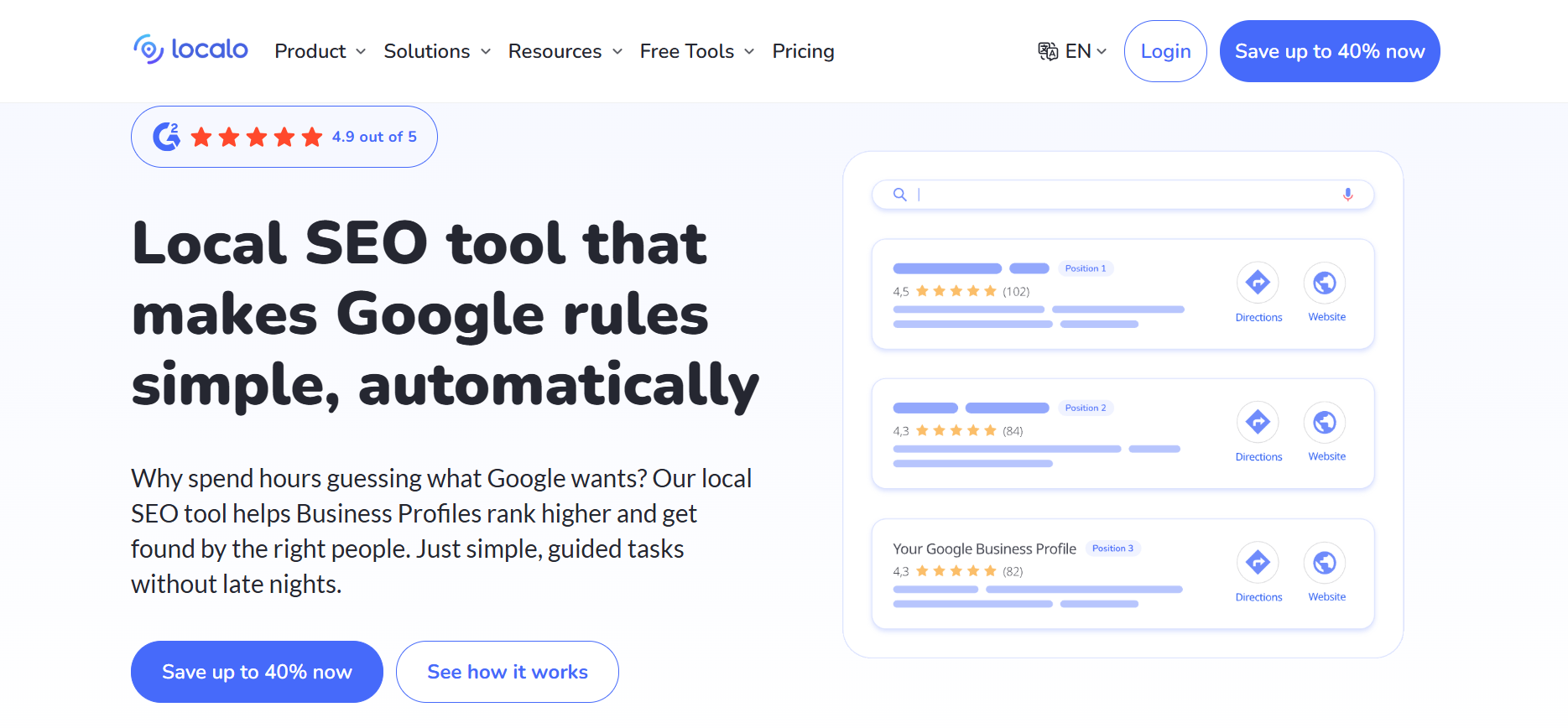
Localo is built specifically to make local visibility easy to see and communicate. It’s based on DAXRM’s Local Rank Tracker technology and centers everything around visual heatmaps: color-coded grids overlaid on a map of your service area, where green means strong rankings and red means invisible. For client reporting, this visual format is extremely effective — clients who would glaze over at tables of keyword positions immediately understand a heatmap showing their business getting more visible over time.
Localo handles the core local tracking use case well: customizable geo-grids, pin tracking for important locations, and competitor overlay showing where competitors dominate versus where you do. The starting price of $27/month for a single profile is competitive.
The limitation is depth. Localo doesn’t offer the additional SEO tooling (site audits, backlinks, keyword research) that platforms like Nightwatch include. Integrations are more limited, and the data export options are less flexible than enterprise-grade tools. It’s a good fit if your workflow is specifically about visual reporting of local grid data and you have separate tools for everything else.
Pricing: Starts at $27 per month for a single business profile.
Pros
- Excellent heatmap visualization that non-technical clients immediately understand
- Intuitive competitor overlay on the same grid
- Flexible custom geo-grid tracking
- Accessible price point
Cons
- Limited additional SEO tools beyond local rank tracking
- Fewer integrations than comprehensive platforms
- Reporting is heavily visual with limited raw data export
- Email-only customer support
Best for: Businesses and consultants focused specifically on visualizing and communicating local grid data to stakeholders.
5. Keyword.com
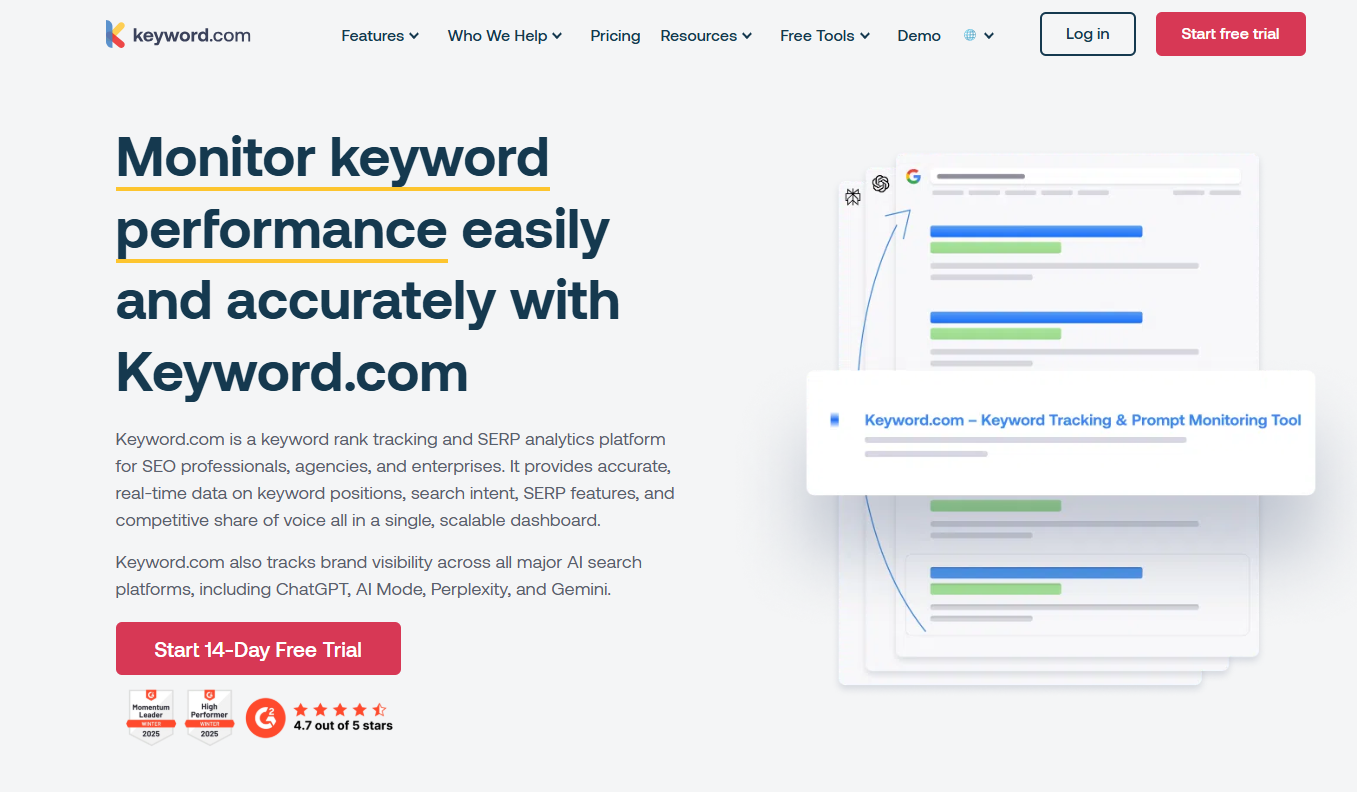
Keyword.com delivers solid local rank tracking at a price accessible for small businesses and solo consultants. It tracks performance in organic results, Local Pack, and Google Maps, with historical data for trend analysis, multi-location support, local ranking grids, and adjustable map sizes.
Beyond rank tracking, a subscription includes keyword research and prospecting tools, search volume trends, competitor tracking, and Share of Voice metrics. Basic site audit and technical SEO checking add further value at the entry-level price point.
The interface is functional rather than polished — heatmap visualization is less sophisticated than premium alternatives, and the local-specific UX shows less investment than tools built exclusively around local search. But for small businesses that need reliable local ranking data without enterprise costs, Keyword.com delivers the essentials cleanly.
Pricing: Starts at $16 per month with a 14-day free trial.
Pros
- Most affordable professional local rank tracking option
- Accurate GPS coordinates-based tracking
- Includes keyword research and prospecting
- Basic site audit and technical SEO checking
- Free trial with transparent pricing
Cons
- Less sophisticated visual interface than premium alternatives
- Limited heatmap capabilities for geographic visualization
- Fewer local-specific features than dedicated platforms
Best for: Small businesses and solo consultants needing accurate local rank tracking without enterprise costs.
Comparison Table: Best Local Rank Tracking Tools
| Tool | Local Grid Tracking | GBP Monitoring | Daily Updates | Starting Price | Best For |
|---|---|---|---|---|---|
| Nightwatch | Yes — GPS geo-grid heatmap | Yes — integrated | Yes | $32/mo | Agencies and businesses needing full local tracking + GBP monitoring + white-label reports |
| AccuRanker | Yes — GPS-precise, limited heatmap | Partial | Yes + on-demand | $249/mo | Large enterprises needing instant on-demand refresh |
| BrightLocal | Yes — grid with pin tracking | Yes — via GBP reports | Yes | $49/mo | Full-service local SEO agencies needing citation + review management |
| Localo | Yes — visual heatmap focus | Partial | Yes | $27/mo | Businesses prioritizing visual client reporting |
| Keyword.com | Yes — basic grid | No | Yes | $16/mo | Small businesses needing affordable rank tracking |
Frequently Asked Questions
What’s the difference between local and regular rank tracking?
Regular rank tracking shows average rankings without caring where people actually search from. Local rank tracking uses GPS coordinates to show exactly where you rank from different locations throughout your service area. Local trackers also monitor Local Pack position and Google Maps rankings — critical placements that don’t exist in traditional organic results. See the full breakdown in our local SEO guide.
How accurate are local rank tracking tools?
Modern tools using GPS coordinate-based tracking are highly accurate, typically within 1-2 positions of what real searchers see. Accuracy depends on geo-grid technology precision, update frequency, and tracking method. Tools with daily ranking scans provide more accurate trending data than weekly updates that miss important shifts.
Keep in mind: local search results can vary slightly based on search history and personalization even from the same location. Rank trackers typically show “clean” unPersonalized results, which might differ slightly from individual searcher experiences. For making optimization decisions and measuring progress, the accuracy is more than sufficient.
Can I track rankings for multiple business locations?
Yes. All major tools offer multi-location tracking, though sophistication varies. You can track each location separately with its own custom geo-grid, keywords, and competitors. Nightwatch and BrightLocal are particularly strong for multi-location management, with individual visibility heatmaps per location plus consolidated reporting across your entire portfolio. For multi-location strategy context, see our local SEO checklist.
How often should I check my local rankings?
Weekly monitoring hits the sweet spot for routine oversight — daily fluctuations are normal and don’t always signal real problems. Pay closer attention during active optimization campaigns (check daily to assess impact quickly), after major GBP updates (monitor daily for 1-2 weeks to catch issues early), and in highly competitive markets where competitor activity can shift the Local Pack significantly overnight.
What’s the most important feature in a local rank tracking tool?
GPS-precision geo-grid tracking is the foundation — without it, you’re getting approximate city-level data that doesn’t reflect actual customer experience. After that, prioritize daily update frequency (so you catch Local Pack changes quickly), Google Business Profile integration (to connect GBP activity to ranking changes), and reporting quality relevant to your use case: visual heatmaps for client communication or raw data export for in-depth analysis.
Found the Right Local Rank Checker Yet?
Local SEO is about understanding exactly where your business appears in search results and taking targeted steps to improve visibility. Start by tracking your rankings across all key locations, monitoring both broad and long-tail keywords, and keeping an eye on competitor performance. Pay attention to your Google Business Profile and customer reviews, making sure your information is consistent and accurate across directories. Use insights from your data to adjust your content, optimize keywords, and target neighborhoods where you’re underperforming. For the complete approach, the local SEO checklist is a good starting point.
If you haven’t chosen a local rank checker yet, Nightwatch is the standout option: GPS-precise geo-grid tracking, daily updates, GBP monitoring, competitor heatmaps, and white-label reports — all in one platform starting at $32/month.
Try it for free today and see exactly where your business stands and where you can grow.