
SEO Automation: What to Automate, What to Keep Human, and How to Do It Right
Quick Takeaways
- Nearly 44% of SEO tasks can now be automated; most teams are only scratching the surface
- Rank tracking, technical audits, keyword research, content workflows, backlink monitoring, and AI visibility monitoring are all automatable to varying degrees
- Most automation guides stop at traditional search. They skip the entire AI visibility layer entirely
- Good SEO automation frees your team from repetitive work so they can focus on the judgment calls that actually move the needle
- A well-built SEO automation stack compounds: each layer you automate frees up attention for the work that actually moves rankings
Introduction
It’s Monday morning. A senior SEO manager has eleven tabs open. Three client reports need to be built from scratch. The rank data sitting in the dashboard is already four days old. A Slack message just came in asking why organic traffic dropped last week, and there’s no good answer yet because no one caught it when it happened.
Across town, a competitor’s team got an automated alert on Friday. They’d already diagnosed the issue, queued a fix, and moved on.
SEO has expanded far beyond what any team can track manually. You’re now responsible for technical health, content production, keyword strategy, rank monitoring across hundreds of terms, and brand visibility inside AI-generated search responses. Each of those areas generates data constantly. Most of it goes unread because there aren’t enough hours.
SEO automation is how you close that gap. This guide covers every major SEO function that can be automated, where human judgment still wins, and how to build a stack that runs in the background while your team focuses on the work that actually requires a brain.
What Is SEO Automation?
SEO automation is the use of software to handle repetitive, data-driven SEO tasks that don’t require creative thinking or human judgment on each execution. That means scheduled crawls that flag broken links without anyone asking for them, rank data that updates daily without someone logging in to pull it, and reports that land in a client’s inbox without a team member spending hours formatting a spreadsheet.
The concept isn’t new. Scheduling a Screaming Frog crawl is a form of automation. What has shifted is the intelligence behind it. Early automation tools ran predefined checks and handed you a list of tasks to execute. Modern platforms use AI to identify patterns, surface priorities, and in some cases, take corrective action automatically.
A tool that tells you a page is missing an H1 is useful. A tool that catches missing H1s, cross-references them with keyword data, suggests copy, and flags them for review is a different category of product entirely.
There are three distinct modes of SEO automation worth understanding:
- Monitoring automation runs continuously in the background, tracking rankings, crawling for technical issues, watching competitor movements, and flagging anomalies as they happen rather than when someone remembers to check.
- Execution automation handles the output side: generating keyword lists, drafting content briefs, building internal link suggestions, and fixing on-page issues.
- Reporting automation takes your data and turns it into formatted, scheduled reports delivered to the right people without anyone touching them.
What automation doesn’t replace: strategy, creative judgment, and relationship-driven work. AI can surface which keywords to track. It can’t decide which market you should be building authority in.
Which SEO Tasks Can Be Automated? (And How Far Can You Push It?)
The honest answer: more than most teams are currently automating. According to recent research, 44.1% of SEO tasks are now being automated by AI tools, and teams using automation consistently save more than five hours per week on core workflows. That number climbs significantly for agencies managing multiple clients.
Here’s a breakdown of the major SEO task categories, how far automation can go, and where you still need a human in the loop.
| SEO Task | Automation Level | Time Saved | Key Risk If Mishandled |
|---|---|---|---|
| Rank tracking & SERP monitoring | Full | High | Low (pure data) |
| Technical site audits | Full | High | Low (flagging only) |
| Keyword research & clustering | Partial | High | Medium (intent misclassification) |
| Content gap analysis | Partial | Medium | Low |
| Content brief generation | Partial | Medium | Medium (requires editorial review) |
| Content writing (first drafts) | Partial | High | High (needs human edit before publish) |
| Backlink monitoring | Full | Medium | Low |
| Backlink outreach research | Partial | Medium | Medium |
| AI search visibility monitoring | Full | High | Low (pure tracking) |
| SEO reporting | Full | Very High | Low |
| Link building (actual outreach) | Not recommended | n/a | High (penalty risk) |
| Content strategy decisions | Not recommended | n/a | High (wrong focus) |
Keyword Research and Clustering
Manual keyword research (pulling volumes one term at a time, grouping them by hand, classifying intent from intuition) is the clearest automation win in SEO. Tools can now bulk-generate hundreds of related terms from a few seed keywords, pull search volume and difficulty data automatically, group clusters by semantic similarity, and flag keyword cannibalization across your existing content.
AI keyword research tools go further, using NLP to classify intent (informational, transactional, commercial) at scale. You’d still need a human to decide which clusters to actually pursue based on business priorities, competitive positioning, and available resources. But automation tools drastically reduce the manual workload, so you can quickly make an informed call.
From there, workflows can move seamlessly into keyword clustering without you spending days in a spreadsheet.
Content Gap Analysis and Topic Ideation
A content gap analysis used to mean spending hours manually comparing your site’s coverage to competitor rankings, hoping you’d spotted the right holes. Automation flips this. Tools crawl your domain and your competitors’, map what’s ranking versus what you’ve covered, and surface the specific topics you’re missing, sorted by opportunity size.
This is a high-value, low-risk automation. The tool isn’t making creative decisions; it’s doing a comparison that would otherwise take days. A thorough content gap analysis run automatically every month means you’re never more than a few weeks behind on spotting what you should be building.
Content Briefs, Writing Assistance, and On-Page Optimization
AI can generate a structured content brief in minutes, including your target keyword, secondary terms, recommended headers, and even suggested internal links. This replaces hours of manual prep per piece.
That same automation extends beyond planning into execution. AI content optimization tools scan your existing content against target keywords, flag thin or underdeveloped sections, surface missing semantic terms, and recommend structural improvements. Instead of waiting for manual audits, they work through your content library continuously in the background.
Do keep in mind that automated first drafts and briefs need a human editorial pass before anything goes live. Search engines are rewarding expertise, original perspective, and depth. Tools can scaffold the content. Your team adds what actually makes it worth reading.
Technical SEO Audits
Technical SEO is one of the best fits for full automation. Crawling for broken links, missing H1s, redirect chains, duplicate meta descriptions, slow-loading pages, indexation issues, Core Web Vitals flags: all of this can run on a schedule and surface exceptions automatically.
A technical issue caught the day it occurs causes far less damage than one that goes unnoticed for weeks. Continuous monitoring helps you fix problems before they start affecting rankings or visibility.
To make sure nothing slips through the cracks as your site scales, use a technical SEO checklist to validate that your automated crawls are covering all critical areas.
Rank Tracking and SERP Monitoring
Rank tracking is the original SEO automation use case, and it’s still one of the most important. Automated rank monitoring tracks keyword positions across search engines, devices, and locations daily. No one needs to log in and pull data. Alerts fire when significant position changes happen, so your team finds out about a ranking drop the same day it occurs rather than the next time someone thinks to check.
Modern rank trackers go beyond position data. They track SERP feature appearances (featured snippets, knowledge panels, local packs), competitor position changes, and ranking velocity over time. Nightwatch monitors rankings across 190,000+ locations down to ZIP code level, useful for any team managing local SEO at scale or tracking how rankings vary by geography.
Backlink Monitoring and Link Opportunity Research
Backlink monitoring is another strong full-automation candidate. Tools continuously scan your backlink profile, alert you when links are lost, flag new links from high-authority domains, and surface toxic links that may need to be disavowed. All without anyone manually pulling a backlink report.
On the research side, automation can find competitor backlinks at scale, cluster link opportunities by domain authority and topical relevance, and surface prospecting lists your team would take weeks to build by hand. The research is automated. The outreach still needs a human. We’ll get into that later.
AI Search Visibility Monitoring
Most SEO teams have built solid automation for traditional search. Almost none have built it for AI search, and that’s a significant blind spot.
A March 2026 analysis of 680 million AI citations found that 73% of B2B buyers now use tools like ChatGPT and Perplexity during their research process. These platforms are already shaping brand perception before users ever reach a search engine. So when someone asks an AI model which tools to use in your category, your brand needs to appear. If it doesn’t, competitors who do appear get the consideration instead.
The problem is that you can’t track this manually. AI models generate different responses to the same prompt depending on timing, location, and phrasing. Testing prompts by hand gives you a snapshot, not a trend. Meaningful AI visibility tracking requires automated, repeated querying across a consistent set of prompts. That’s the only way to get share-of-voice data you can actually act on.
Nightwatch’s AI & LLM Tracker does this automatically. It tracks brand mentions, sentiment, average position, and share of voice across ChatGPT, Perplexity, Google AI Mode, and AI Overviews on a daily basis. This gives you a consistent view of how your brand is being represented in AI-generated answers over time, so you can spot shifts early and understand where you’re gaining or losing visibility.
Automated SEO Reports
Report generation is one of the highest time-cost tasks in any SEO workflow, and it’s almost entirely automatable. Scheduling weekly or monthly reports to pull fresh data (rankings, organic traffic, backlinks, technical health) and deliver them formatted and ready to share eliminates one of the biggest recurring drains on SEO team time.
Research from BeastMetrics found that agencies using automated SEO reporting software acquire 40% more clients and achieve 91% higher client satisfaction scores than those relying on manual workflows. When clients get consistent, accurate updates automatically, trust builds without anyone on your team spending time maintaining it.
What Should Never Be Fully Automated in SEO?
Link Building Outreach
Automated link building (mass emails, bulk directory submissions, automated comment posting) creates low-quality backlinks that harm rather than help rankings. Search engines are sophisticated enough to detect unnatural link patterns, and the penalty risk is real.
The research side of link building automates well: finding prospects, qualifying domains, and identifying contact details. The actual outreach needs a human behind it. For a framework that pairs automated research with human-led outreach, see our in-depth guide on link-building strategies.
Content Strategy Decisions
Tools can surface keyword data, gap analysis, competitor coverage, and search volume trends. They can tell you what topics exist and how competitive they are. But they can’t tell you which angle will build authority for your specific brand, which topics align with your business objectives, or where to focus a 12-month content plan.
Content strategy is a judgment call. Automation gives you better information to make it with, but the decision stays with your team.
Interpretation and Client Communication
Automated reports deliver data. They don’t explain what it means in the context of a specific campaign, a recent algorithm update, or a client’s business goals. The analysis layer (why rankings moved, what the data suggests you should do next, how to frame a difficult month) requires a person who understands the full picture.
Clients don’t pay agencies for data. They pay for the thinking that turns data into decisions. Automate the data delivery. Keep the thinking human.
How to Build Your SEO Automation Stack (Layer by Layer)
A well-built SEO automation stack isn’t a single tool. It’s a set of interconnected systems, each handling a different layer of your workflow.
Layer 1: Monitoring
This is the foundation. Before you automate anything else, get continuous monitoring in place across four areas.
- Rank tracking: Keyword positions updated daily, with alerts for significant drops. This is the signal layer; everything else depends on knowing when something changes.
- Technical health: Scheduled crawls for broken links, missing tags, Core Web Vitals regressions, and indexation issues. Set alerts, not just dashboards. You want to know when something breaks the same day it happens, not during a monthly review.
- Backlink changes: Automated alerts for lost links, new toxic links, and significant competitor link acquisitions.
- AI search visibility: Brand mentions across ChatGPT, Perplexity, and Google AI Mode tracked on a consistent prompt set. This layer is newer, but skipping it means you have no visibility into how AI search is affecting your brand’s discovery.
Layer 2: Research
Once monitoring is running, layer in automated research to feed your content and keyword strategy.
- Keyword discovery: Automated pulls from keyword planning tools, Search Console data, and competitor gap analysis. Build a weekly feed of new keyword opportunities into your workflow rather than running research as a one-off project.
- Content gap scanning: Automated comparison of your content library against top-ranking competitors on your core topics, surfacing gaps on a schedule.
- Competitor intelligence: Tracking competitor ranking movements, new content they’re publishing, and links they’re acquiring automatically.
Layer 3: Execution Assistance
- Content briefs: Auto-generated from keyword cluster data and SERP analysis.
- On-page recommendations: Automated scanning of existing content against target keywords, surfacing pages that need updates and what those updates should cover.
- Internal link suggestions: Tools that identify internal linking opportunities across your content library, finding pages that should be linked but aren’t, based on topical relevance and current link equity.
- Technical fixes: For straightforward issues (missing alt text, title tag truncation, duplicate descriptions), automated fix queuing means your dev team handles a prioritized list rather than a raw audit dump.
Layer 4: Reporting
The final layer: make sure the right people see the right data at the right time, automatically.
Scheduled reports pulling from your rank tracker, analytics, and Search Console data should land in inboxes on a fixed cadence, weekly for active campaigns and monthly for client reviews. White-label reporting handles the formatting, so your team doesn’t spend hours on presentation.
Where Nightwatch fits in
Most teams stitch together three or four separate tools to cover what Nightwatch handles in one dashboard. Here’s how each layer maps to the platform.
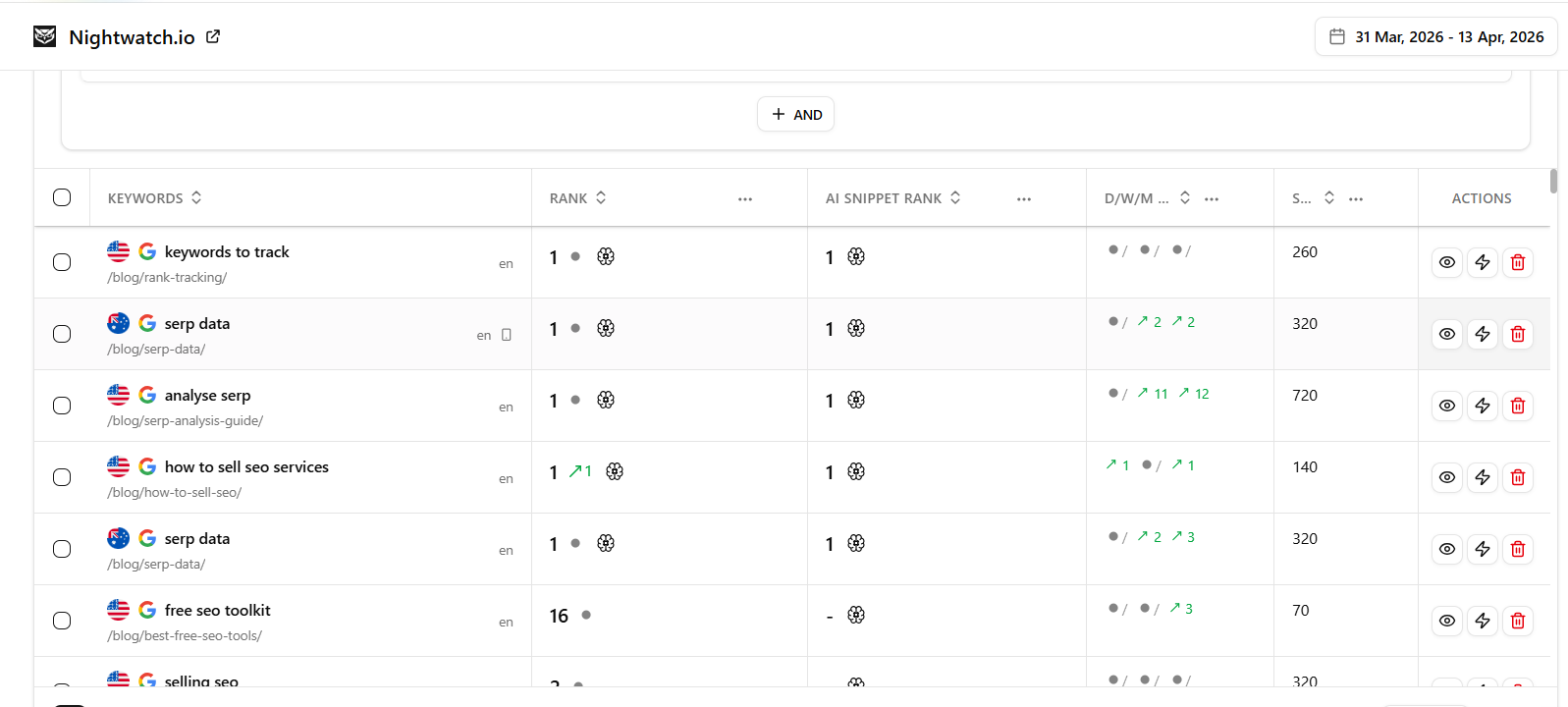
Tracking rankings and AI visibility, side by side
The main Nightwatch dashboard tracks both traditional keyword rankings and AI search visibility in the same view. You can see where your brand ranks on Google alongside how often it appears in ChatGPT, Perplexity, and Google AI Mode responses, without switching platforms or reconciling data from different sources.
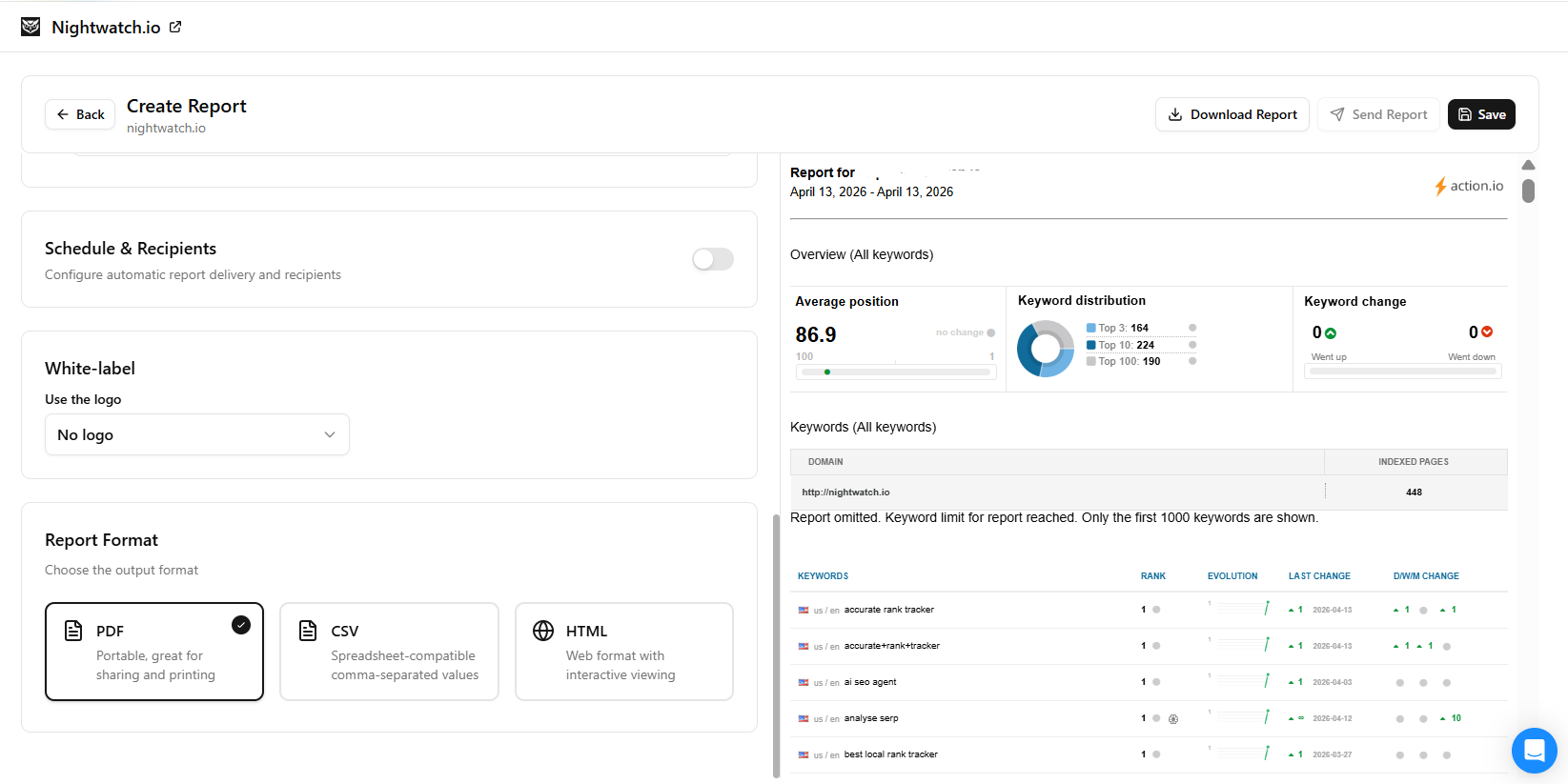
Automated reporting, scheduled, and white-labelled
Inside the reports section, you can set up automated reports to go out on a fixed schedule, weekly, monthly, or custom, branded with your agency or company identity. Set the recipients once, and the reports land in the client or stakeholder inboxes automatically.
 \
\
Research, clustering, and briefs with NightOwl
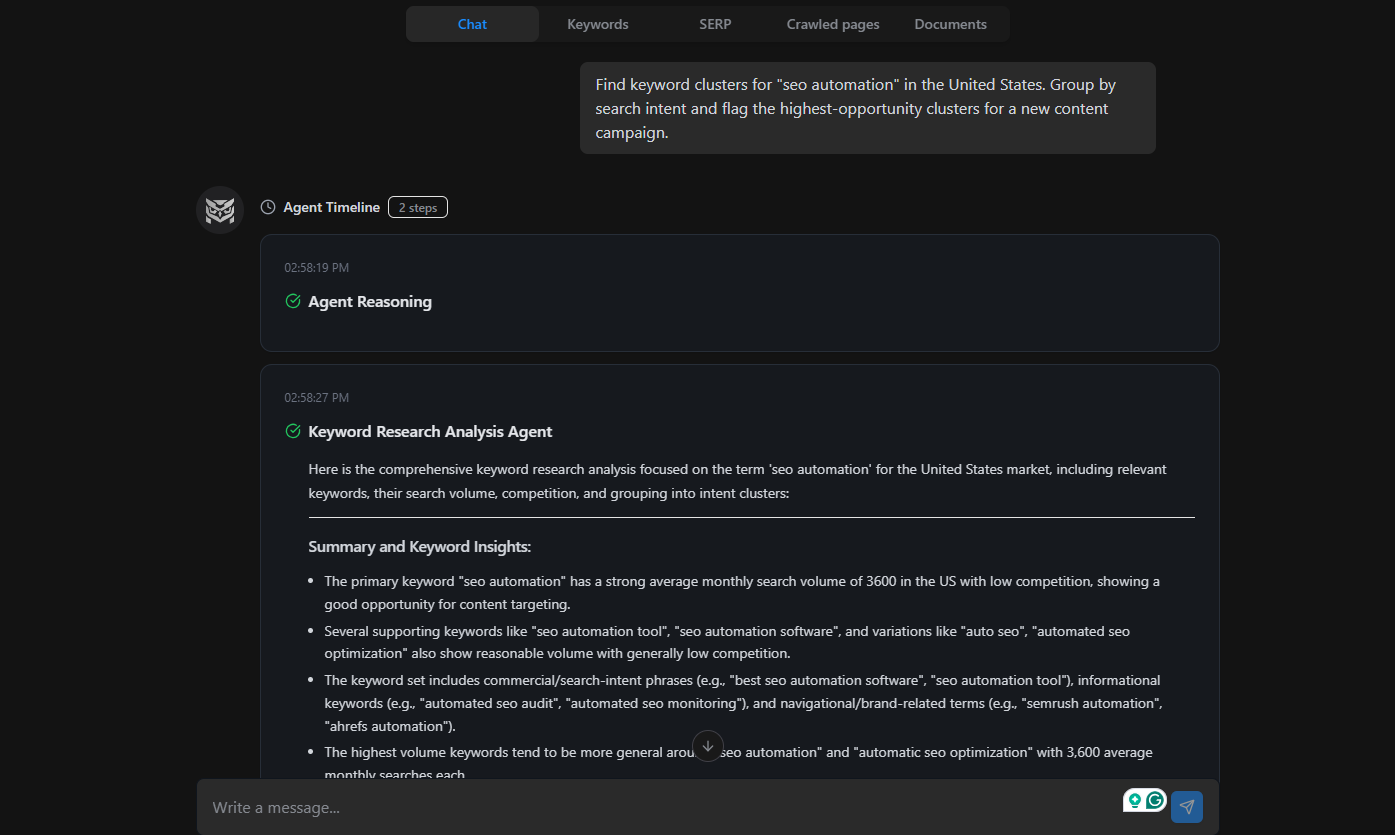
NightOwl is Nightwatch’s built-in AI SEO agent. It handles the research layer through a simple chat interface. You can handle keyword research, content gap analysis, keyword clustering, and content brief generation by simply prompting it like you do ChatGPT. The key difference is that NightOwl integrates with Google Search Console and uses live SERP data, which helps deliver highly accurate SEO insights.
It also runs technical SEO crawls, surfacing issues like broken links, missing H1s, and site structure problems so you can rule them out before they affect rankings.
A typical starting workflow looks like this:
Sample prompt: “Find keyword clusters for [your topic] in [target location]. Group by search intent and flag the highest-opportunity clusters for a new content campaign.”
NightOwl returns clustered keyword groups with search volumes, intent classifications, and suggested content angles. From there, you can prompt it to generate a content brief for any cluster directly.
The result is a single platform covering rank tracking, AI visibility monitoring, automated reporting, and research workflows, replacing what most teams currently handle across three or four separate tools.
How Do You Know Your SEO Automation Is Working?
Automation creates a problem if you’re not careful: you get more data without a clear way to evaluate whether it’s actually improving outcomes. These are the metrics worth tracking.
Time Saved Per Workflow
Measure actual hours before and after automation for your highest-frequency tasks: rank checking, report building, and technical audits. If you’re not saving meaningful time, the automation either isn’t set up correctly or isn’t covering the right tasks.
Issue Detection Speed
How quickly are you catching technical problems? The benchmark to aim for: issues detected within 24 hours of occurring, not at the next scheduled review. Monitoring automation that misses week-old problems isn’t running at the right frequency.
Ranking Velocity
Are rankings on actively targeted keywords improving faster than before? Automation doesn’t directly move rankings, but faster issue detection, more consistent technical health, and better-informed content decisions should show up in ranking velocity over time.
AI Visibility Score Over Time
If you’re tracking AI search visibility, watch your share of voice trend across your core prompt set month-over-month. According to Search Engine Land, share of voice tracking measures how often your brand appears across a consistent set of high-value queries, providing a benchmark to track against competitors over time. An improving trend means your content and entity signals are registering in AI-generated responses.
The Compounding Effect
SEO automation compounds in ways that aren’t obvious at first. Monitoring that runs longer builds better historical data, which makes anomaly detection more accurate. Keyword research that feeds a consistent content workflow builds topical authority faster than sporadic manual pushes. Reporting that goes out consistently keeps client relationships healthier without more hours from your team.
The return on a well-built automation stack grows over time. The cost of not building it (missed issues, slow response, incomplete visibility) also grows.
Frequently Asked Questions About SEO Automation
Can SEO be fully automated?
No, and any tool claiming otherwise is overpromising. The repeatable, data-heavy tasks automate well: rank tracking, technical audits, keyword research, backlink monitoring, reporting. Strategy, creative judgment, and relationship-driven work still require humans. The practical goal is partial automation across most functions, not full automation of any single one.
What’s the difference between SEO automation and AI SEO?
SEO automation is the broader category, using software to handle repetitive tasks on a schedule or trigger. AI SEO is a subset: it uses machine learning to analyze data, surface insights, and make recommendations that would otherwise require human analysis. A scheduled crawl is automation. A tool that identifies which pages to prioritize for optimization based on traffic potential and technical health, and explains why, is AI SEO. Most modern platforms blend both.
Is automated SEO safe? Will it get my site penalized?
For monitoring, reporting, rank tracking, and technical auditing: zero penalty risk. Automation here is safe, standard practice. The risk comes from automating things that shouldn’t be automated: bulk link schemes, AI-generated content published without editorial review, or spammy directory submissions. Use automation to improve speed and coverage, not to scale tactics that violate search engine guidelines.
How much time can SEO automation actually save?
Research shows that teams save more than five hours per week on average once core workflows are automated. For agencies managing multiple clients, the number is higher.
Do I need technical skills to automate my SEO workflow?
Not anymore. A few years ago, meaningful SEO automation required API integrations, custom scripts, and developer support. Modern platforms have moved the complexity under the hood. Chat-based AI agents like NightOwl let you kick off research, auditing, and content tasks by describing what you want in plain language. No code required. The barrier to building a solid automation stack is lower than most teams expect.
Scale SEO Automation with Nightwatch
SEO automation doesn’t replace your team’s judgment. It handles the repetitive, high-volume work so your team can focus on the decisions that actually require one.
Tasks like rank tracking, technical audits, AI visibility monitoring, and reporting all have components that can run automatically, and more accurately than any manual process. That frees your team to focus on the decisions, relationships, and creative work that actually require a person.
To see what a complete SEO automation stack looks like in a single platform, try Nightwatch for free. It runs rank tracking and AI visibility monitoring, and pairs with NightOwl for keyword research, technical SEO, and content support autonomously, so nothing falls through the gaps.